
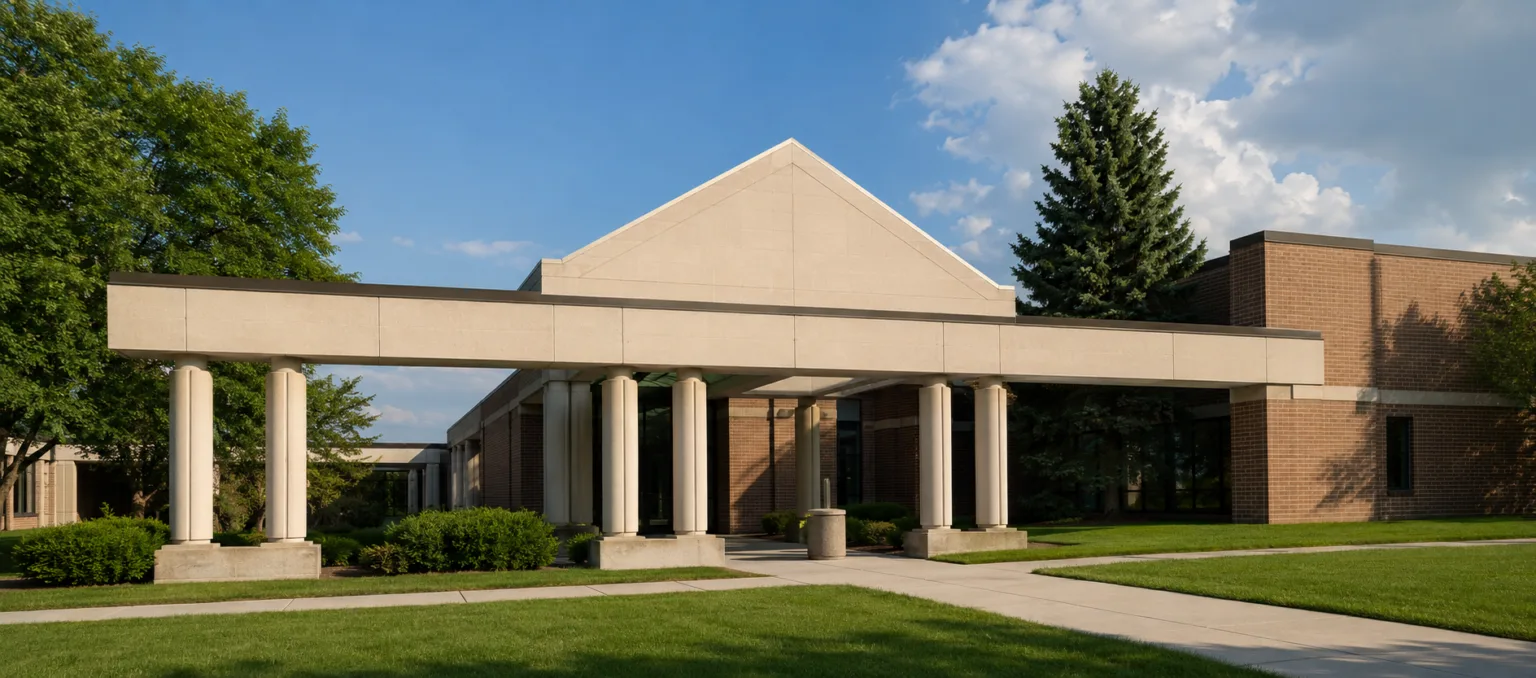

DUI cases in the 52-4 District Court of Troy
Our firm has a long history with the 52-4 District Court in Troy. Founder Jeffrey Randa opened his first office in the city back in 1993, and the 52-4 was where he spent the early years of his career handling criminal and DUI cases. That history gives us a perspective on this court that goes back decades — and the honest assessment, after all of it, is that the 52-4 is one of the better courts in the Metro Detroit area to face a DUI or OWI charge.
The 52-4 District Court has jurisdiction over all cases arising in the City of Troy, and also handles cases from the neighboring City of Clawson. Troy alone has a population approaching 100,000, and with both I-75 and M-59 cutting through it — along with dozens of major surface roads — it generates a steady, substantial volume of OWI cases. That volume, combined with the court’s central location in Oakland County, makes the 52-4 one of the busier district courts in the region.
The purpose of this article is simple: if you or someone you care about is facing a DUI or other criminal charge in the 52-4 District Court, you want to know what to expect. What follows is a real-life overview of how this court operates, based on our firm’s firsthand experience there.
The Judges of the 52-4 District Court
The 52-4 District Court is currently presided over by two judges: Judge Kirsten Nielsen Hartig, who has been on the bench since 2010, and Judge Maureen M. McGinnis, who joined the court in 2014. Both have been lawyers since before they took the bench — Judge Nielsen Hartig since 1996, Judge McGinnis since 2003.
We won’t rank judges against each other or get into résumé territory. What actually matters to someone facing a DUI is a straightforward question: are these judges fair? The answer, in both cases, is yes.
Both judges are intelligent, patient, and — importantly — they explain the reasoning for their decisions. That last point matters more than it might seem. In a criminal or DUI case, a judge who takes the time to explain a decision shows that the person before them was truly heard, and his or her statements were genuinely considered. That’s not always guaranteed in every courtroom.
In Troy, it is.
Neither judge has a temper, a rigid agenda, or any other characteristic that keeps defense lawyers up at night. They apply the law, they follow the evidence, and they treat the people in their courtroom with decency, fairness, and respect. If your case ends up in the 52-4, you can breathe a sigh of relief that you wound up here, rather than somewhere else.
What Kind of Court Is the 52-4?
The first goal in every DUI case is to find a way to get the charge dismissed outright, or at least reduced to something less serious — like Operating While Visibly Impaired (OWVI). Whether that’s possible depends on the facts of each case, and a careful and comprehensive examination of the evidence is always the starting point. If the case can’t be thrown out of court, then the focus shifts to avoiding as much of the fallout — meaning as many of the legal penalties and negative consequences as possible.
When it comes to how this court handles DUI cases that go through to sentencing, the 52-4 is genuinely fair. It is not any kind of hardline court where a first-time offender walks away feeling like the system wanted to make an example of them. Compared to some courts in the region that have trended harder in recent years, the 52-4 stands out as decidedly reasonable.
Jail on a first offense DUI is exceptionally rare here. Absent truly extraordinary aggravating factors, it is not a realistic outcome. Probation is essentially a given in any Michigan DUI case — that is true statewide and the 52-4 is no exception — but probation in this court is always reasonable and, by comparison, not overly strict. The court’s requirements are not unreasonable, and its approach to compliance is always fair-minded.
Fines and costs in the 52-4 are in line with what one would expect across the region — never excessive, never out of proportion.
How Cases Are Prosecuted
How a DUI case is prosecuted in the 52-4 depends on where the arrest occurred and how the charge is brought. Michigan’s dual-track prosecution system means that most DUI cases can be charged either as a violation of state law — MCL 257.625 — or as a local ordinance violation.
For cases arising in the City of Troy, prosecution is handled by the city’s in-house attorney’s office. For cases arising in Clawson, the city uses a private law firm to handle its ordinance prosecutions, as many municipalities do. State-level charges in both cities — usually involving an arrest by the Michigan State Police or, in many cases, the Oakland County Sheriff’s Department — are handled by the Oakland County Prosecutor’s Office.
The practical significance of the dual-track system is that it gives experienced defense counsel the opportunity to work toward a favorable outcome that reflects who the client is as a person. That’s critically important, because it’s easy to be swept through the court system as merely one of many files. Our job is to make sure the client is seen as a real, worthwhile person — a law-abiding, tax-paying member of the community — and not just another case.
First Offense DUI in the 52-4
A first offense OWI in Michigan is a misdemeanor carrying up to 93 days in jail, fines, license sanctions, and probation. In the 52-4, jail on a first offense is extremely rare. The court recognizes that most first-offense DUI cases involve people who have no meaningful prior record and whose situation does not call for incarceration.
Nowadays, probation in a DUI case is virtually certain no matter where it occurred, and that is no different here. What sets the 52-4 apart is that its probation terms tend to be reasonable, and the overall approach is accommodating, not burdensome and punitive.
A first offense OWI with a BAC of .17 or above triggers the High BAC enhancement, which carries increased potential penalties. Even with that enhancement, the 52-4 handles these cases with a mindset of understanding rather than an intention to hammer someone with punishment. The focus remains on what is appropriate given the full circumstances.
Second Offense DUI in the 52-4
A second offense OWI in Michigan is a misdemeanor that carries up to one year in jail, higher fines, and a mandatory driver’s license revocation. The license revocation on a second offense is automatic — there is no judicial discretion to avoid it.
One important exception to mandatory revocation exists for those who enter a sobriety court program. The 52-4 District Court operates Drug Therapy Court (DTC), an 18-month specialty-docket program for participants ready to address addiction and recovery. Participation can, in the right circumstances, allow a participant to avoid the mandatory license revocation that would otherwise apply to a second offense — a significant practical benefit that is worth discussing with an attorney.
Our firm has handled many second-offense cases in the 52-4. The court approaches these cases seriously, as it should, but it does not abandon its even-handed character simply because the stakes are higher.
Drug Therapy Court (DTC) — 52-4 District Court
The 52-4 operates Drug Therapy Court (DTC), an 18-month specialty-docket program for participants addressing addiction and recovery. For eligible second-offense cases, participation may allow a defendant to avoid the mandatory license revocation that ordinarily applies. For more on how sobriety courts work across Metro Detroit, see our overview of sobriety courts in the Detroit area.
Third Offense DUI in the 52-4
A third offense OWI within 10 years is a felony under Michigan law, carrying up to five years in prison, substantial fines, and a mandatory five-year driver’s license revocation. When a third-offense charge lands in the 52-4 District Court, the case begins there but will be bound over to Oakland County Circuit Court for felony proceedings if the evidence supports it.
Third-offense cases require careful, experienced handling from the outset. The decisions made at the district court level — before any bind-over — can have significant consequences for how the case ultimately resolves.
The City of Troy and the 52-4’s Jurisdiction
Troy is one of the largest and most commercially active cities in Metro Detroit. With nearly 100,000 residents, major corporate headquarters, two large shopping malls (Somerset Collection and Oakland Mall), Troy Beaumont Hospital, and a dense network of major roads, it is both a destination and a pass-through for an enormous volume of daily traffic. Big Beaver Road (often called “16 Mile”), is one of the region’s most heavily traveled commercial corridors, and between it and the other large arteries running through the city, the volume of DUI cases the 52-4 District Court handles reflects just how much activity flows through Troy on any given day.
Troy is one of several Oakland County courts our firm regularly handles. For a closer look at how nearby courts operate, see our overviews of the Rochester Hills 52-3 District Court and the Clarkston 52-2 District Court.
Facing a DUI in the 52-4 District Court? Call Our Office.
Our firm has been handling DUI cases in the 52-4 District Court for more than 30 years. We know this court very well, we know how it operates, and we know what it takes to get the best possible outcome under the circumstances.
We offer free, confidential phone consultations. Reach our office Monday through Friday, 8:30 a.m. to 5:00 p.m., at 586-465-1980. An after-hours answering service is available. You can also reach us through the contact form or chat box on our Michigan DUI defense page.