
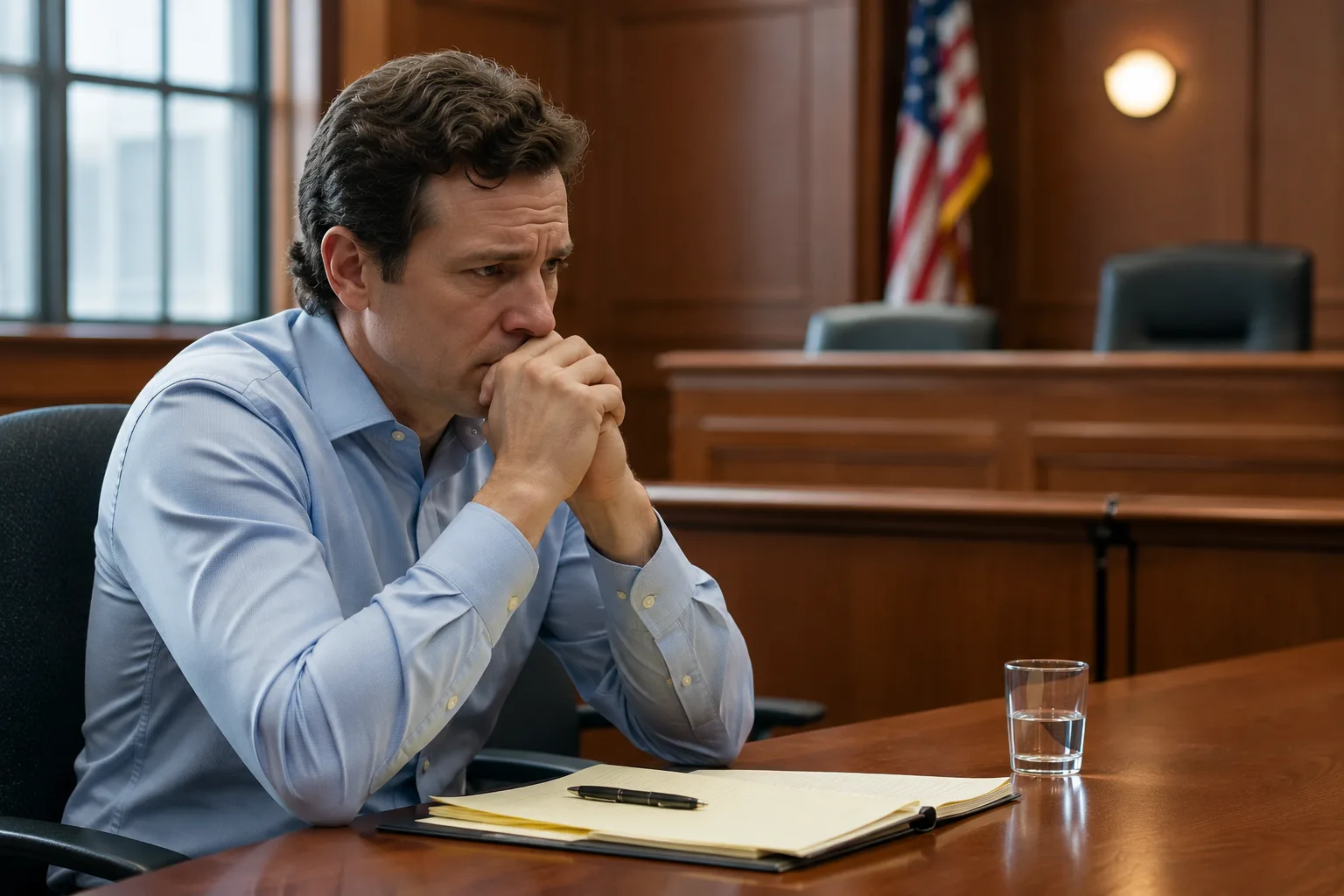

Navigating Probation Violations in Michigan
If you are facing a probation violation in Michigan, the one thing you need to understand right away is that going to jail is not inevitable — but the risk is real, and it does not get smaller by waiting. A probation violation puts you back in front of the same judge who already gave you a break. That judge is not going to be happy. What happens next depends almost entirely on who is standing next to you when you walk in.
Our firm handles probation violation cases in the Metro-Detroit area courts of Wayne, Oakland, and Macomb, and the surrounding counties every day. We know these judges, we know what works and what doesn’t, and we know how to keep you out of jail and from otherwise getting hammered.
What Is a Probation Violation in Michigan?
Probation is a break. When a judge places someone on probation rather than sending them to jail, he or she is essentially saying: I’m giving you a chance to remain free. In court, a VOP (violation of probation) happens when a person either does something specifically forbidden or fails to do something required under the terms of the court’s order.
There is no less legally sophisticated area of criminal and DUI practice than handling a probation violation. Unlike a criminal trial, where guilt must be proven beyond a reasonable doubt, a probation violation only needs to be established by a “preponderance of the evidence” — meaning all that needs to be shown is that it’s more likely than not that the violation occurred. That is a much lower bar, and it means that the outcome of a PV case rarely turns on some clever legal argument or technical challenge to the evidence.
Instead, a probation violation case is almost always about one thing: persuading the judge to give you another chance rather than sending you to jail or slapping you with all kinds of new and burdensome conditions. That requires a very specific kind of lawyer — and not necessarily the same kind of lawyer who wins murder trials.
The Most Common Probation Violations
Probation violations span the full range of criminal cases — DUI, drug offenses, domestic violence, assault, embezzlement, and more. By far the most common violation, in our experience, involves testing positive for alcohol while on probation. Missing a required breath or urine test runs a close second. Behind those, the list includes:
- A positive alcohol or drug test
- A missed or skipped breath or urine test
- Getting arrested for or charged with a new offense
- Being caught driving without valid license privileges
- Failing to complete required counseling, classes, or treatment
- Violating a no-contact order
Of course, some violations are worse than others. Picking up a new criminal charge while on probation is far more serious than a single missed alcohol test. And a fourth violation is in a very different category than a first one. Context matters enormously.
When the Violation Isn’t Really Your Fault
There are cases where the alleged violation is simply wrong — a botched alcohol or drug test, a clerical error, a miscommunication about whether a required class was completed. In those situations, our job is to prove to the court that the violation did not occur.
These cases are less common than people hope. The honest truth is that most probation violations happen because the person on probation genuinely screwed up in some way. If that’s the situation you’re in, the goal shifts entirely: rather than fighting the violation, we focus on making sure the judge doesn’t respond to it by sending you to jail, putting you on house arrest, or otherwise making your life a lot harder.
What Happens After a Probation Violation Is Reported?
Once a violation is reported, the probation officer will file a written report with the court describing what you allegedly did or failed to do. In many cases, a warrant is issued for your arrest. If you have a lawyer, he or she can often arrange for you to turn yourself in voluntarily rather than waiting to be picked up — which matters.
Once you appear in court, you will go through a probation violation arraignment, where the alleged violation is read to you, your rights are explained, and you are asked how you plead.
Always plead not guilty at the arraignment, even if you know you violated. This preserves your options and gives your lawyer time to develop a strategy. When you have a lawyer present, the judge will also know that you intend to handle this properly. Having a lawyer at your arraignment typically results in the court allowing a personal bond — meaning you walk out without posting any money.
Under Michigan law, a probation violation hearing must be scheduled within 14 days of the arraignment. In practice, we often waive that timeline and ask for more time. Getting extra time almost always pays off — it allows us to take the proactive steps that can make the difference between walking out of the hearing or being taken into custody.
What to Do Before the Hearing — This Matters More Than Most People Realize
One of the most important things anyone facing a probation violation can do is not wait. Taking action before the hearing — and being able to show the judge what you’ve done — can be the difference between going home and going to jail.
Depending on the nature of the violation, helpful steps can include:
- Getting a substance abuse evaluation — if the violation involves alcohol or drug use, a proper evaluation from the right evaluator can completely reframe how the judge sees the situation. We work with specific evaluators whose reports are thorough, credible, and tailored to the purpose at hand.
- Starting counseling or treatment — individual, group, or intensive outpatient, depending on what fits the circumstances. The goal is to show the judge that meaningful change has already begun, not that you’re promising to change in the future.
- Attending AA, SMART Recovery, or another support program — if appropriate to the situation.
- Completing whatever was missed — if the violation involves failing to complete a required class or community service, finishing it before the hearing speaks loudly.
- Gathering documentation — proof of attendance, employment, family responsibilities, anything that builds the picture of a person worth another chance.
The judge wants to know one thing: will you follow the rules if given another chance? Everything we do before that hearing is aimed at answering that question convincingly.
Technical Violations and the Jail Cap
Michigan law distinguishes between technical violations and non-technical violations, and the distinction matters significantly for how much jail time a judge can impose.
Technical violations include:
- Failing an alcohol or drug test
- Failing to provide a required breath or urine sample
- Not paying all fines and costs
- Not completing required community service
Non-technical violations include things like:
- Absconding — failing to report to probation for more than 60 days
- A violation of any state or federal law, even if no criminal charges result
- Consuming alcohol on probation following a 3rd offense OWI or other felony DUI conviction
- Violating a no-contact order in a domestic violence case
For technical violations, Michigan law caps the jail time a judge can impose:
Technical Violations — Misdemeanor Cases:
- First violation: not more than 5 days
- Second violation: not more than 10 days
- Third violation: not more than 15 days
- Fourth or subsequent: any number of days, not to exceed the remaining eligible jail sentence
Technical Violations — Felony Cases:
- First violation: not more than 15 days
- Second violation: not more than 30 days
- Third violation: not more than 45 days
- Fourth or subsequent: any number of days, not to exceed the remaining eligible jail or prison sentence
For non-technical violations, the judge has full discretion to impose any sentence up to the maximum for the original offense. That is a far more dangerous situation.
The goal in every probation violation in Michigan, regardless of category, is to avoid any jail time at all. There is not a single person who, given the choice between zero days and even one day in jail, would choose the one day. Our job is to make zero happen.
Why This Kind of Case Requires a Very Specific Kind of Lawyer
A probation violation case is not won because of some scholarly legal argument. It’s not about motions, evidence challenges, or clever briefs about constitutional rights. In most PV cases, the evidence that a violation occurred is overwhelming and not seriously in dispute. The person drank. They missed the test. They picked up a new charge. There’s no getting around it.
What this situation calls for is a skilled diplomat — someone who can walk into that courtroom, face a judge who is frustrated and possibly angry, and genuinely persuade him or her to give the client another chance. That requires charisma, credibility, and a deep understanding of what that specific judge responds to.
Think of it this way: the lawyer who wins high-profile murder trials is often the most aggressive, confrontational attorney in the room. In a probation violation, that same aggressive style is exactly wrong. Making an angry judge angrier never helps. A probation violation requires someone more like a skilled negotiator than a street fighter — someone with, as we say, enough charm to sell Bibles to atheists.
Here’s something most lawyers won’t tell you: tactical legal skills and an encyclopedic knowledge of evidentiary rules are about as helpful in a probation violation case as ballet slippers in a football game. What matters is the ability to just “know” what to do — and that instinct comes only from years of standing in front of these same judges in these same courts.

Local Court Knowledge Is Not Optional
Even if you’ve been to the same court ten times as a party or a witness, that qualifies you to know a judge about as well as having ten fillings qualifies you to be a dentist. Knowing a judge — really knowing how they think, what they want to hear, what makes them more patient and what makes them less — comes only from appearing in front of them regularly as a lawyer.
Our firm handles probation violations throughout Wayne, Oakland, and Macomb, and the surrounding counties. We are in these courts consistently. Among the courts where we see the highest volume of probation violation cases:
- Bloomfield Hills
- Clarkston
- Clinton Township
- Farmington Hills
- Macomb County Circuit Court in Mt. Clemens
- New Baltimore
- Novi
- Oakland County Circuit Court in Pontiac
- Plymouth/Canton
- Rochester Hills
- Romeo
- Royal Oak
- Shelby Township
- Sterling Heights
- Troy
- Warren
- Wayne County Circuit Court in Detroit
- Woodhaven
- Wyandotte
Wherever your case is pending, this is not the time for your lawyer to be learning what will and won’t fly with the judge overseeing your violation. We already know.
A Note on DUI Probation Violations
While probation violations arise across every area of criminal law, the most common, by far, involves someone on probation for a drunk driving offense testing positive for alcohol. DUI probation violations present their own specific challenges, particularly around the alcohol-related conditions that courts routinely impose and what it means when those conditions are not followed.
If your probation violation stems from a DUI case, our article on DUI probation in Michigan covers the specific conditions, testing requirements, and realistic outcomes in much greater detail. The information here applies to any probation violation, regardless of the underlying offense.
Why People Choose Jeffrey Randa & Associates for Probation Violations
Our firm handles only criminal, DUI, and driver’s license restoration cases. We are in court every day — often multiple times in a single day — handling exactly these kinds of cases. That means the judges we stand in front of know us, trust our word, and are familiar with how we handle things.
We are also genuinely selective about the cases we take and honest about what we can and cannot accomplish. If you are facing a fourth violation after three prior violations because you picked up a new criminal charge, our team is going to tell you the truth about what you’re realistically facing — not what you want to hear. That kind of candor is rare in this business, and it matters. The last thing anyone in trouble needs is a lawyer who soft-pedals reality just to get the retainer.
What we can tell you honestly is this: in the vast majority of probation violation cases we handle, our clients do not go to jail. That is not a promise, because every case is different and every judge is different. But it is a genuine reflection of what we accomplish day in and day out.
Our firm lives by the principle that success in a probation violation is best measured by what does not happen to you. Every decision we make — how we approach the judge, what we present, what we say and don’t say — is aimed at one outcome: making sure the worst doesn’t happen to you.
Ready to Talk? Consultations Are Free and Confidential
If you are facing a probation violation anywhere in Wayne, Oakland, or Macomb, or the surrounding counties, our firm is ready to help. We handle these cases every day in the local courts, and we know what it takes to keep you out of jail.
Our consultations are free, confidential, and done over the phone — right when you call. There’s no pressure, no commitment, and no obligation. Our team will answer your questions directly, explain exactly what you are facing, and let you compare notes with anything another attorney may have told you.
We are available Monday through Friday, 8:30 a.m. to 5:00 p.m., at 586-465-1980. An after-hours answering service is also available. You can also reach us through the contact form or chat box on our website.
If you are facing a probation violation, visit our probation violations practice page to learn more about how we can help.
Frequently Asked Questions
Will I go to jail for a first probation violation?
Not necessarily, and avoiding jail is the entire reason you hire a lawyer. For technical violations, Michigan law caps the jail time a judge can impose — 5 days for a first misdemeanor technical violation, 15 days for a first felony technical violation. But even within those caps, a skilled lawyer’s job is to push the result to zero. Judges are never required to impose any jail time; they are only limited in the maximum they can give.
How is a probation violation different from a criminal charge?
The standard of proof is completely different. A criminal charge must be proven beyond a reasonable doubt. A probation violation only needs to be proven by a preponderance of the evidence — simply meaning “more likely than not,” by just the slightest margin. That lower standard means violations are harder to fight on the merits, which is why the lawyer’s role shifts from arguing the evidence to persuading the judge.
How long can I be held in jail for a probation violation?
It depends on whether the violation is technical or non-technical, and whether the underlying offense is a misdemeanor or felony. Technical violations carry statutory caps ranging from 5 to 45 days depending on the number of violations and the offense level. Non-technical violations — such as picking up a new criminal charge — expose a person to the full remaining sentence for the original offense, with no cap.
How do I clear a probation violation warrant?
You appear in court for an arraignment, where the warrant is recalled. Always plead not guilty at this stage, regardless of the facts. Having a lawyer present will also typically result in a personal bond, meaning you leave without posting money. Your lawyer can then request additional time beyond the 14-day hearing deadline to develop a strategy — which almost always pays off.
Is a probation violation a felony or misdemeanor?
Neither, technically — a probation violation is a proceeding, not a new charge. Whether it is handled as part of a felony or misdemeanor case depends on what the underlying conviction was for. The risk of punishment in each is different, which is why the distinction matters.
Do the rules of evidence apply at a probation violation hearing?
No. The rules of evidence do not apply, which means hearsay is admissible and the procedural protections of a criminal trial are not present. Combined with the lower preponderance standard, this makes probation violation hearings a very different environment from a criminal trial — and underscores why the lawyer’s persuasive skills matter far more than technical legal knowledge.
What if my DUI probation violation involves a positive alcohol test?
A positive test while on probation for a DUI is the most common probation violation we see. It does not automatically mean jail, but it does mean the judge is going to want answers. Our DUI probation article covers the specific landscape of these cases in more detail.