


DUI and the HGN (“Follow With Your Eyes, Not Your Head”) Test
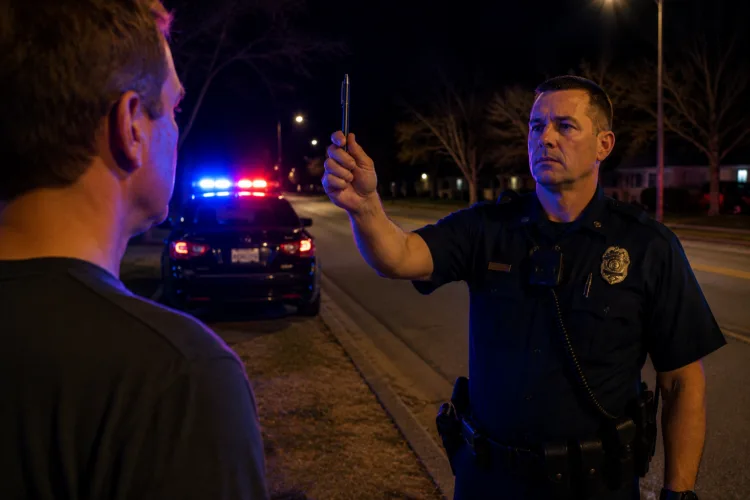
If you’ve been stopped for a suspected OWI in Michigan, there’s a good chance the officer asked you to follow a pen or finger with your eyes. That’s the Horizontal Gaze Nystagmus test — almost always called the HGN test — and it’s one of three Standardized Field Sobriety Tests (SFSTs) that law enforcement uses as part of an OWI investigation.
Officers and prosecutors often present the HGN test as hard science — an objective, reliable indicator of alcohol impairment. The reality is considerably more complicated. The research literature on HGN is surprisingly thin when it comes to real-world reliability, and what independent scientists have found is not flattering. This article takes a close look at what the science really shows, what Michigan courts have actually said about the test, and what it means for someone facing an OWI charge.
What Is Nystagmus, and Where Does the HGN Test Come From?
Nystagmus is an involuntary, rhythmic jerking of the eyes. It has dozens of recognized causes and is a well-documented neurological phenomenon. In clinical medicine, physicians use lateral gaze nystagmus to assess neurological injury, brain lesions, and cerebellar disease. No medical school trains physicians to use nystagmus to estimate blood alcohol content — that’s not what the test was designed for, and this use has never been validated in a clinical setting.
The HGN test as used by law enforcement was developed in the late 1970s at the Southern California Research Institute under a federal contract with the National Highway Traffic Safety Administration (NHTSA). Dr. Marcelline Burns led the research. The goal was to identify roadside behavioral indicators that could help officers establish probable cause for a DUI arrest. That work ultimately produced the three-test SFST battery — the HGN, the Walk-and-Turn, and the One-Leg Stand — which NHTSA standardized and has promoted ever since.
The key phrase in that history is “under a federal contract.” The foundational research was funded by the same government agency that then promoted and trained officers based upon the results it thought it had found. Critically, that research was never subjected to independent peer review. That’s the standard process the scientific community uses to evaluate whether research methodology and conclusions are sound.
The Research Foundation Is Weaker Than Prosecutors Suggest
The accuracy figures attached to the HGN test — claims of 77%, 88%, or even higher depending on the source — come almost entirely from the original NHTSA-commissioned studies. Independent scientists who have examined those studies have found significant problems with their methods.
Dr. Steven Rubenzer, a forensic psychologist, published a peer-reviewed critical review of the SFST literature in Law and Human Behavior (American Psychological Association) that identified a fundamental flaw in how the NHTSA field studies were structured: the studies validated officer arrest decisions, not the tests themselves. In those field studies, officers already had full access to the subject’s appearance, demeanor, driving behavior, and odor of alcohol. The field sobriety test results were never evaluated in isolation. In other words, the studies cannot tell us how well the HGN test performs on its own — only how officers performed overall when they had everything available to them, including the test.
Dr. Michael Hlastala and colleagues published a statistical reanalysis of the NHTSA data in the Journal of Forensic Science and found that the accuracy of the SFST battery “is much poorer than that indicated” by NHTSA’s own published figures. More specifically, their analysis showed that SFST accuracy fell to roughly 37% at a BAC of 0.07% — just below the legal limit — meaning the tests were barely better than a coin flip for people near the legal threshold. They concluded that the tests are “likely to be mainly useful in identifying subjects with a BAC substantially greater than 0.08%.”
Rubenzer and Stevenson later published a focused review of the HGN test specifically, titled “Horizontal Gaze Nystagmus: A Review of Vision Science and Application Issues,” in the Journal of Forensic Sciences (55(2), 394–409, 2010). Their conclusion: HGN testing “is limited by a large variability in the underlying normative behavior,” and the inconsistent conditions of roadside testing further compromise whatever reliability the test might have under ideal laboratory conditions.
Put in simple terms, the HGN test does not produce results that are highly reliable.
Experienced Officers Called Sober People Drunk Almost Half the Time
One of the most important studies in this area — and one that deserves far more attention in DUI defense discussions — was published in Perceptual and Motor Skills in 1994 by Dr. Spurgeon Cole and Ronald Nowaczyk of Clemson University. Cole was an expert in testing and measurement, and the study was peer-reviewed.
The methodology was straightforward: fourteen experienced law enforcement officers — with a median of nearly 12 years on the job — were shown videotapes of 21 individuals performing field sobriety tests. They were asked to identify which subjects had consumed too much alcohol to drive. The officers concluded that, on average, 46% of the subjects were too impaired to drive.
Every single subject had a BAC of 0.00%. Not one of them had consumed a drop of alcohol.
Think about what that means. Experienced police officers, watching people perform the same tests used to justify OWI arrests every day, concluded that nearly half of a group of completely sober individuals were drunk. The study has never been meaningfully refuted, and its findings are consistent with the error rates found in NHTSA’s own original 1977 research, which produced a false-positive rate of 47%.
Inter-Rater Reliability: Officers Don’t Even Agree With Each Other
A valid scientific test needs to produce consistent results regardless of who is administering it. In the measurement world, this is called inter-rater reliability, and it is typically expressed as a correlation coefficient — with 1.0 being perfect agreement and 0.0 being no agreement at all. For a test to be considered scientifically reliable, the standard in behavioral science is a coefficient in the high 0.80s to 0.90s. The SAT, as a benchmark, exceeds 0.90.
When different officers administer the HGN test to the same subjects at the same BAC level, the inter-rater reliability coefficient drops to 0.57 — a figure drawn from NHTSA’s own data. That number falls far below any recognized threshold for scientific acceptability. To put it plainly: when two officers test the same person, they frequently disagree about what they saw, so their conclusions are NOT reliable.
This isn’t a minor quibble. It goes to the heart of whether HGN is measuring something objective or whether it is primarily a reflection of individual officer perception and interpretation. If that’s not enough, a study of 53 actual dashcam recordings found that only one of 53 officers conducted the HGN test in strict compliance with NHTSA protocol. One out of fifty-three did it right.
Nystagmus Has Dozens of Causes That Have Nothing to Do With Alcohol
There are more than 40 medically recognized types of nystagmus. Officers are trained to recognize three categories. The gap between what a trained officer knows about nystagmus and what a neurologist or ophthalmologist knows is significant, and it matters enormously when the question is whether the eye movement an officer observed was caused by alcohol or by something else entirely.
Documented non-alcohol causes of horizontal nystagmus include:
- Benign paroxysmal positional vertigo (BPPV) — the most common cause of horizontal nystagmus in the general population
- Vestibular neuritis and Menière’s disease
- Multiple sclerosis
- Cerebellar degeneration (the eye movement pattern alcohol produces is clinically indistinguishable from what cerebellar disease produces, as documented in peer-reviewed neurological research)
- Brain lesions, head trauma, and stroke
- Inner ear infections (otitis media)
- Diabetes
- Fatigue
- Numerous prescription medications, including anticonvulsants, antihistamines, and sedatives
- Naturally occurring nystagmus — present in approximately 4% of the general population even without any substance in their system
- Optokinetic nystagmus — caused by watching moving contrasting images, such as the flashing lights of a police vehicle at night
That last one is worth pausing on. The police vehicle’s flashing lights, which are often directly in a subject’s field of vision during a roadside stop, are a textbook trigger for optokinetic nystagmus — a form of eye jerking that can be indistinguishable from alcohol-induced HGN to a non-specialist. NHTSA protocol requires the test to be conducted away from flashing lights specifically because of this. In practice, that requirement is frequently not followed.
What Michigan Law Says About the HGN Test
In Michigan, the controlling case on HGN admissibility is People v. Berger, 217 Mich App 213 (1996). The Michigan Court of Appeals held that because HGN has gained general acceptance in the relevant scientific community — a conclusion worth noting was reached in 1996, before most of the independent peer-reviewed literature reviewed above existed, and one that the research calls into serious question — the prosecution does not need to call an expert to lay a scientific foundation every time it wants to use HGN evidence. The requirement is simpler: the prosecution must show that the officer was qualified to administer the test, and that the test was properly performed.
That second requirement is where HGN evidence frequently runs into problems. People v. Mullen, 282 Mich App 14 (2008), found that an officer who held the stimulus 4–6 inches from the defendant’s face — instead of the required 12–15 inches — administered the test in a non-standardized manner, directly affecting its admissibility. Michigan’s 2016 statute, MCL 257.62a, added a “substantial compliance” standard, meaning any meaningful deviation from NHTSA protocol is grounds for a legal challenge.
There is another limitation in Berger that is often overlooked in practice. The court was careful to say that HGN is admissible only to show the presence of alcohol — not the quantity, and not the BAC level. The court explicitly noted that it was unaware of any Michigan court that had permitted HGN to be used to quantify how much alcohol was present. In other words, an officer can testify about what was observed during the HGN test. What an officer cannot do is testify that the defendant “failed” in a way that implies their BAC was at or above 0.08%. That inference is not supported by Berger, and it is not supported by the science.
What This Means in a Real OWI Case
None of this means that HGN evidence disappears in a Michigan OWI case, or that a jury will disregard it. Courts have accepted HGN as admissible evidence, and juries hear it. What it does mean is that HGN evidence is not the airtight scientific proof it is often made out to be, and a well-prepared defense attorney knows how to put it in its proper context.
Our team reviews the HGN evidence in every OWI case. We look at whether the officer was properly trained and certified, whether the test was administered in strict compliance with NHTSA’s protocol (stimulus distance, speed of movement, number of passes, positioning relative to traffic and flashing lights), and whether there are medical or environmental explanations for any observed nystagmus. We also evaluate what the officer is claiming the HGN shows — because in Michigan, that testimony has legal limits.
Perhaps more important, we look at the totality of the evidence. HGN is only one piece of an OWI investigation. The breath or blood test result, the officer’s observations of driving behavior, the client’s demeanor, what was said at the stop — all of it matters. A competent OWI defense means understanding how the pieces fit together, where the weaknesses are, and what the realistic options are for getting the best outcome.
Should You Refuse the HGN Test?
In Michigan, field sobriety tests — including HGN — are voluntary. There is no license sanction and no criminal penalty for refusing them. We have written about this in more detail on our field sobriety test page, but the short answer is that by the time an officer is asking you to perform the HGN test, they have typically already formed a suspicion of impairment. Performing the test gives the officer additional information and documentation to support an arrest. Declining leaves them with less.
That said, refusing hardly guarantees you won’t be arrested, and an officer who already has adequate probable cause will proceed regardless. The decision is fact-specific and situational. What we can say with confidence is that HGN test results are not nearly as determinative as they are sometimes made to appear, and there is substantial scientific literature supporting that position.
Facing an OWI Charge in Metro Detroit? Talk to Our Team.
Our firm handles OWI cases throughout Wayne, Oakland, and Macomb, and the surrounding counties. If you’ve been charged with an OWI and want to understand the real state of the evidence in your case — including what the HGN results mean and don’t mean — we’d welcome the chance to talk through it with you.
We offer free, confidential phone consultations Monday through Friday, 8:30 a.m. to 5:00 p.m., at 586-465-1980. An after-hours answering service is available outside those hours. You can also reach us through the contact form or chat box on our website. For a full overview of how we approach OWI defense in Michigan, visit our DUI/OWI practice page.
Sources and Further Reading
Peer-Reviewed Scientific Literature:
- Cole, S. & Nowaczyk, R.H. (1994). “Field Sobriety Tests: Are They Designed for Failure?” Perceptual and Motor Skills, 79, 99–104.
- Rubenzer, S.J. & Stevenson, S. (2010). “Horizontal Gaze Nystagmus: A Review of Vision Science and Application Issues.” Journal of Forensic Sciences, 55(2), 394–409.
- Hlastala, M., Polissar, N. & Oberman, S. (2005). “Statistical Evaluation of Standardized Field Sobriety Tests.” Journal of Forensic Science.
- Rubenzer, S.J. (2008). “The Standardized Field Sobriety Tests: A Review of Scientific and Legal Issues.” Law and Human Behavior, American Psychological Association.
- Romano, F. et al. (2017). “Gaze-evoked nystagmus induced by alcohol intoxication.” The Journal of Physiology. PMC5350443.
Michigan Case Law:
- People v. Berger, 217 Mich App 213; 551 NW2d 421 (1996)
- People v. Mullen, 282 Mich App 14 (2008)
- MCL 257.62a (2016 “substantial compliance” statute)
Bar Journal / Legal Analysis:
- Oklahoma Bar Journal (2021), “Are the Standardized Field Sobriety Test Validation Studies Reliable?”