
Michigan Driver’s License Restoration Appeal DENIED – What it Means to Lose
If you have lost a license restoration appeal in Michigan, you are not alone — and you are probably wondering what happens next. In our roles as Michigan driver’s license restoration lawyers, we handle over 200 license-related cases each year. Many of the people who ultimately become our clients do so after either having tried and lost a “do-it-yourself” driver’s license appeal, or after having hired some other lawyer and then lost. It seems strange to say this, but these people are the easiest clients for us, because they don’t need to be convinced that the license appeal process is complex. Most just find this blog, read some articles, and then call us, wanting to know how soon we can get started.
Can You Appeal to Circuit Court After Losing?
Some of those who contact us want to know if we can go to court and appeal to overturn their losing decision. It is understandably hard for people to accept losing, especially if they are genuinely sober. They’ll inevitably conclude that the hearing officer made a mistake, and that an appeal to circuit court will give them a chance to correct it. We then have to explain that a license appeal is about proof, and that even if somebody has honestly given up drinking, the Michigan Secretary of State’s job is to evaluate the evidence presented and determine if it meets the “clear and convincing” standard required by law to win.
In almost every case, an appeal to circuit court after losing a license restoration appeal in Michigan is a losing proposition. The simple fact is that when some “do-it-yourselfer” or some other lawyer loses, my team and I are almost always not interested in challenging the hearing officer’s decision, because in almost every one of those cases, we can see the errors the person or their lawyer made that led to the denial in the first place. Whatever else, we don’t make those kinds of mistakes, and that’s why we guarantee to win every driver’s license restoration and clearance case we take.
A Real-Life Example From Circuit Court
All self-praise aside, there is a very important reality here. Here is a real-life example from some years ago that illustrates the point:
Jeffrey Randa was in a local circuit court one day when a case was called for a lawyer who had appealed a losing decision issued by the Michigan Secretary of State in a driver’s license restoration case. The Judge, who was meticulous in her ruling, explained why she had to deny the circuit court appeal in a way that stuck with him ever since.
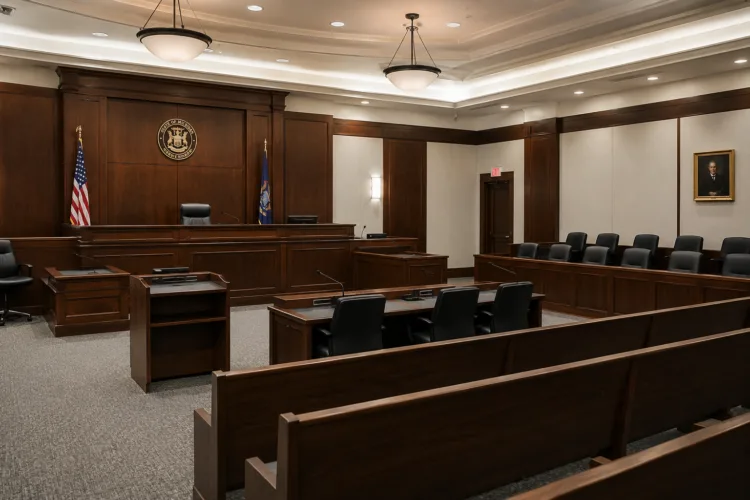
First, she noted that the written rule regarding license appeals instructs the hearing officer to deny a license appeal unless the person proves his or her case by “clear and convincing evidence.”
The Judge then made clear that she believed the client was, in fact, genuinely sober, and further stated that, if she had been the hearing officer deciding the case, she would have granted the license.
As she clarified, though, that is not what an appeal to circuit court is all about.
The Judge went on to explain that a hearing officer is afforded broad discretion in deciding these cases, and that the only way for her to overturn the hearing officer’s decision on appeal is if it is not supported by “material and competent evidence.”
In other words, the fact that the hearing officer reached a different conclusion than the Judge would have — had she been the one originally deciding the case — is not enough to reverse it.
Instead, a person appealing a losing decision to circuit court must show that the hearing officer’s decision is essentially without any evidentiary support. Remember, anyone filing a license appeal not only has to be sober but must also prove it by “clear and convincing evidence.”
In other words, the evidence a person submits must prove sobriety in a way that basically leaves no doubt that not only has he or she quit drinking, but also that he or she is a safe bet to never drink again.
In the real world, hearing officers don’t get this wrong very often — and certainly not in any way that Judges will second-guess. To be sure, plenty of genuinely sober people end up denied by the Secretary of State, but that doesn’t, in any way, violate the law.
What the Law Requires in Every License Restoration Appeal in Michigan
The law requires that a person not only be sober but also prove it with evidence that is clear and convincing. This means showing that he or she has established and is actually living a sober lifestyle — not just claiming one.
Here is the relevant opening portion of the main rule (Rule 13) governing how license appeals are decided:
The hearing officer shall not order that a license be issued to the petitioner unless the petitioner proves, by clear and convincing evidence, all of the following:
i. That the petitioner’s alcohol or substance abuse problems, if any, are under control and likely to remain under control.
ii. That the risk of the petitioner repeating his or her past abusive behavior is a low or minimal risk.
iii. That the risk of the petitioner repeating the act of operating a motor vehicle while impaired by, or under the influence of, alcohol or controlled substances or a combination of alcohol and a controlled substance or repeating any other offense listed in section 303(1)(d), (e), or (f) or (2)(c), (d), (e), or (f) of the act is a low or minimal risk.
iv. That the petitioner has the ability and motivation to drive safely and within the law.
v. Other showings that are relevant to the issues identified in paragraphs (i) to (iv) of this subdivision.
Boiled down, the two key things that must be proven in every license appeal are:
1. That the person’s alcohol problem is “under control,” meaning that the person has been completely abstinent from alcohol for a legally sufficient period of time. This can vary from case to case, but generally speaking, our firm wants at least 18 months of clean time before moving forward, and
2. That the person’s alcohol problem is “likely to remain under control.” This requires showing that he or she has both the ability and commitment to remain alcohol-free — in other words, that he or she is a safe bet to never drink again.
The fact that a person is genuinely sober is not enough, by itself, to win a license appeal case. He or she has to prove it, and do so by that “clear and convincing evidence” standard.
Having used that term multiple times now, a more down-to-earth way to understand it is to think of it as about the equivalent of hitting a home run in baseball, or landing a knockout punch in boxing.
Remember, the opening sentence of the rule instructs the hearing officer to not grant the appeal unless the person does, in fact, hit that home run or land that knockout punch in terms of evidence.
The upshot is that even a “close call” is supposed to be decided against granting the person his or her license back.
What Losing a License Restoration Appeal in Michigan Really Means
So what does it really mean, then, to lose a license restoration appeal in Michigan?
For the most part, it means a person has to wait a full year to try again.
Our firm is in business to make money. We could easily have revenue coming in if we took every case from someone who had lost on their own — or with some other lawyer — and now wants to go to circuit court. But we won’t do that, because in the overwhelming majority of those situations, it would be a waste of the client’s money.
Being honest costs us. There are cases we turn away every year because the circuit court appeal has no real chance of success, and we won’t take a fee for that. My team and I operate by the principle that you treat other people the way you’d want to be treated.
The overwhelming majority of people who lost a “do-it-yourself” license appeal — or who hired a lawyer who didn’t know what they were doing — have no realistic chance of winning a circuit court appeal. We’re not in the business of chasing rare exceptions at a client’s expense.
In general, if you lose a driver’s license restoration case before the Michigan Secretary of State’s Office of Hearings and Administrative Oversight (OHAO), you are going to have to wait a year until you can try again. If you believe a circuit court appeal might be worth exploring, you can read more in our article on what happens when you appeal after a loss — but go in with clear eyes about how narrow that path is.
Whatever your situation, don’t lose sight of the core requirement: you not only have to be sober, but your evidence must prove — by that clear and convincing standard — that you haven’t consumed any alcohol or drugs for a legally sufficient period of time, and that you have both the commitment and the tools to never drink or get high again.
How to Avoid Losing Again
One way to avoid losing a license restoration appeal in Michigan is to make sure you don’t lose in the first place. Thirty-plus years of experience has taught our firm that many people only start digging into what it really takes to win a license appeal after they’ve already tried and failed. If you haven’t lost yet, use that time well — look carefully for the best driver’s license restoration lawyer for your situation, not just someone who claims to “do” these cases.

If you are looking for a lawyer to win back your Michigan driver’s license — or to obtain the clearance of a Michigan hold on your driving record so that you can get a license in another state — be a good consumer, do your homework, and read around. This is all the more important if you’ve already tried and lost. See how lawyers explain the license appeal process and how they approach it. The difference between firms in this practice area is significant.
My team and I can handle any Michigan restoration or clearance case, no matter where in the state, the country, or even the world you may live. We also handle ignition interlock violation cases.
All consultations are free, confidential, and done over the phone. We are happy to answer your questions, explain the process, and even compare notes with anything another lawyer has told you. We’re available Monday through Friday, from 8:30 a.m. to 5:00 p.m., at 586-465-1980. After hours, our answering service is available to take your information.