
Michigan’s Implied Consent Law: What Refusing a Breath or Blood Test Does to Your License
There are two different breath tests in a Michigan drunk driving case, and almost everything on this page depends on which one you refused.
The first is the handheld unit an officer offers at the roadside, or sometimes in the back of a patrol car, before any arrest has been made. That is the preliminary breath test — the PBT. For most drivers, refusing it is a civil infraction that carries a fine and nothing more. No license suspension, and no implied consent consequences at all.
The second comes after you have been arrested, at a police station or a hospital: a breath test on the Intoxilyzer 9000, or a blood draw. That is the test Michigan’s implied consent law governs, and refusing it carries a one-year license suspension on a first refusal — imposed by the Secretary of State, whether or not you are ever convicted of anything in court.
That second one is what the law calls a chemical test refusal, and it is what this article is about. If you refused the roadside handheld and nothing else, most of what follows does not apply to you.
One more thing before we start. This article explains how implied consent works and what happens, step by step, after a refusal at the station. If you have already refused and you are trying to work out what to do right now — what to file, what deadline is coming, and whether you can keep driving — that is covered in a separate piece: What If I Refused the Breath or Blood Test? Here’s What Happens Next. Read that one first if you are in the middle of this. Come back here when you want to understand the law behind it.
What Does Implied Consent Mean?
The phrase has a technical ring to it, but the idea is simple. Anyone who drives on a public road in Michigan is treated as having already agreed — in advance — to take a chemical test if a police officer has probable cause to believe that person was driving while intoxicated.
The consent is called “implied” because you never sign anything and nobody ever asks you. It comes automatically from the act of driving on a Michigan road. When you accept a Michigan license, or drive here on an out-of-state license, the law treats you as having agreed to that condition. The statute is MCL 257.625c, and it has been part of Michigan’s drunk driving law for decades.
This is the kind of thing covered in driver’s education. Whether you remember it does not matter legally. Ignorance of the law is no excuse, and that saying lands hard here: a driver who has never heard the term “implied consent” is bound by it anyway.
The Roadside Test and the Station Test Are Not the Same
Here is each test in full, because people often cannot recall afterward which one they were offered, or when.
The Roadside PBT, Before Any Arrest
The preliminary breath test (PBT) is the handheld device an officer offers at the side of the road, or sometimes in the back of a patrol car, before any arrest has been made. Its purpose is to help the officer decide whether there is probable cause to arrest you. Refusing a PBT is a civil infraction in Michigan. It carries a fine. It does not suspend your license, and it does not trigger implied consent consequences at all.
Two groups face more than a fine:
- A driver under 21 who refuses the PBT gets two points on their driving record.
- A driver operating a commercial vehicle who refuses commits a misdemeanor, punishable by up to 93 days in jail, a fine of up to $100, or both, and receives a 24-hour out-of-service order.
The Station Test, After You Are Arrested
The post-arrest chemical test is the one given after you have been arrested. It is either a breath test on the Intoxilyzer 9000 at a police station or other facility, or a blood draw. This is the test implied consent governs. When you refuse this test, that is a chemical test refusal, and it carries its own consequences, separate from the OWI charge itself under Michigan’s OWI statute, MCL 257.625.
The distinction matters because the two tests serve different purposes, happen at different points, and carry completely different consequences for refusing. The word “refusal” is about all they have in common.
Our article on the roadside test versus the post-arrest test explains how a court uses each result.
What the Officer Has to Read You First
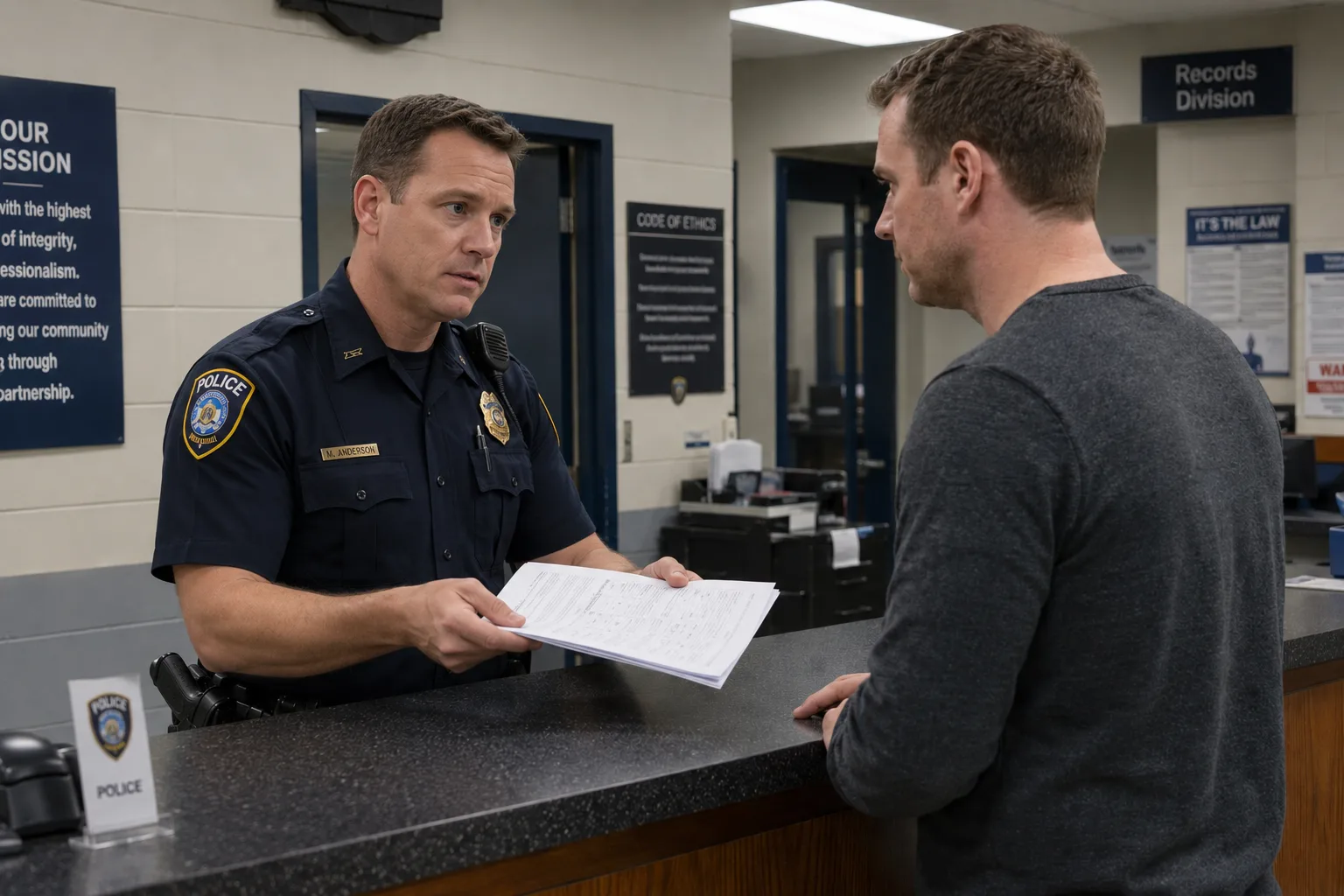
Under MCL 257.625c, before asking you to take a chemical test, the arresting officer has to advise you of certain rights and consequences. This is not optional. It is a prerequisite to a valid implied consent proceeding. Specifically, the officer has to read the following from the DI-177 form:
CHEMICAL TEST RIGHTS
Read the rights that follow in their entirety.
I am requesting that you take a chemical test to check for alcohol and/or controlled substances or other intoxicating substances in your body. IF YOU WERE ASKED TO TAKE OR TOOK A PRELIMINARY BREATH TEST BEFORE YOUR ARREST, YOU MUST STILL TAKE THE TEST I AM OFFERING YOU.
If you refuse to take this chemical test, it will not be given without a court order, but I may seek to obtain such a court order. Your refusal to take this test shall result in the suspension of your operator’s or chauffeur’s license and vehicle group designation or operating privilege, and the addition of six points to your driving record.
After taking my chemical test, you have a right to demand that a person of your own choosing administer a breath, blood, or urine test. You will be given a reasonable opportunity for such a test. You are responsible for obtaining a chemical analysis of a test sample taken by a person of your own choosing.
The results of both chemical tests shall be admissible in a judicial proceeding, and will be considered with other admissible evidence in determining your innocence or guilt.
Will you take a: (Select the appropriate test from the following list)
Breath Test? or Blood Test? or Urine Test?
*MCL 257.625c(2) provides that a person afflicted with hemophilia, diabetes, or a condition requiring the use of an anticoagulant shall not be considered to have given consent to the withdrawal of blood.
Whether the officer did that properly is one of the main grounds for challenging a refusal at an implied consent hearing. If the reading of those rights was incomplete, inaccurate, or never given at all, the Michigan Secretary of State hearing officer who decides your case must rule in your favor.
What Happens to Your License After a Refusal
A refusal sets off a separate, civil proceeding that runs on its own track alongside the criminal OWI case. It is entirely possible to have the OWI charge dismissed and still lose your license over the refusal. The two matters are independent of each other.
The Form the Officer Hands You
At the time of the refusal, the officer fills out a form called the “Officer’s Report of Refusal to Submit to Chemical Test.” You get a copy, and it works temporarily as a paper driver’s license. Your actual license is taken. The paper tells you that you have a right to request a hearing, the deadline for asking, and what happens if you do nothing.
An out-of-state license is not taken.
The 14-Day Deadline
This deadline is the one that ends most of these cases before they start. If you want to contest the suspension, you have to request a hearing within 14 days of getting the Officer’s Report of Refusal. Miss that window and the Secretary of State must automatically suspend your license for a year. There is no grace period and no way to file late. The clock starts the moment the form is issued.
How Long the Suspension Lasts
Under MCL 257.625d, if the refusal stands — either because no hearing was requested or because the hearing officer sided with the officer — the Secretary of State imposes:
- First refusal: one-year license suspension and six points on your driving record.
- Second refusal within seven years: two-year license suspension and six points.
These are on top of any license consequences from the OWI charge itself. If you are convicted of OWI, you face a separate set of license sanctions in addition to the implied consent suspension.
If the same arrest ends in an OWI conviction, the state does not add points for that conviction on top of the refusal points.
When the refusal suspension ends, you pay the Secretary of State a $125 reinstatement fee. Any other suspension or hold on your record, such as one from an OWI conviction, has to be cleared too before you can drive again.
Commercial drivers face a separate set of consequences. If you hold a CDL, a first refusal in a commercial vehicle requires the Secretary of State to suspend every vehicle group designation on your license for a year, so you cannot drive a commercial vehicle that requires one. If you were arrested for OWI, the regular refusal suspension applies as well. A second refusal within 10 years revokes those designations for at least 10 years, and until the Secretary of State approves them again.
Can You Fight the Refusal? The Implied Consent Hearing
If you request a hearing in time, you get one in front of a Secretary of State hearing officer. The scope is narrow. Under MCL 257.625f, only four issues can be raised:
- Whether the officer had reasonable grounds to believe you were operating under the influence of alcohol or drugs;
- Whether you were arrested;
- Whether you were properly advised of your chemical test rights; and
- Whether you refused the test.
If the officer cannot establish all four, or if you establish that any one of them is missing, the hearing officer has to set the refusal aside. If the officer establishes all four and no valid defense applies, the suspension goes into effect.
The hearing is administrative, not criminal. The rules of evidence are relaxed. The officer’s report and testimony carry real weight. But inconsistencies between the report and dash or body camera footage, a failure to properly advise you of your chemical test rights, or a legitimate medical or physical reason for the refusal can all produce a favorable outcome.
A hearing officer who is an attorney employed by the Secretary of State runs the hearing by video, and the arresting officer also appears.
Should You Request a Hearing at All?
Not every refusal is worth fighting at the Secretary of State, and our office does not pretend otherwise.
Some cases are clear. The officer had reasonable grounds, the arrest was good, the rights were read properly, and the refusal happened. When the evidence is that strong and there is no legal basis to challenge it, requesting a hearing and having a lawyer attend it is a way to run up a fee, not a way to win. We do not do that.
What we do instead is look at the evidence first — the police reports, any video, and the rights advisement — and tell you honestly where you stand. If there is a challenge worth making, we request the hearing and we handle it. If there is not, we will tell you that too, and we will walk you through the best course of action from there, which often means moving to the circuit court petition for a restricted license.
Either way, you get a straight answer to decide with, and the 14 days do not pause while you think it over. That is why this is a conversation worth having early rather than late.
Can You Drive While You Wait for the Hearing?
Between the refusal and the hearing decision, you keep whatever kind of license you had before the arrest. That can change as a result of the hearing decision, a DUI conviction, or both.
If You Lose: Asking the Circuit Court for a Restricted License
Whether you missed the 14-day deadline, decided not to request a hearing, or requested one and lost, that is not the end of it. Michigan law gives you a separate route: a petition filed in the circuit court for the county where you live.
This is what people usually call a “hardship” petition. If the court grants it, you get a restricted license — the ability to drive for limited purposes such as work, medical appointments, and other essentials — instead of a full year with no legal way to drive at all. Circuit courts handle these petitions a little differently from one another, but the relief itself is available statewide.
You have to state under oath, and the judge has to find, that you cannot take public transportation and have no family member or other person who can drive you. A restricted license never covers a commercial vehicle that requires a group designation.
This matters more than anything else on this page: a one-year implied consent suspension does not automatically mean a year of not driving. Relief in the form of a restricted license exists, and the circuit court route is open regardless of what happened — or did not happen — at the Secretary of State.
If you had another refusal suspension in the seven years before this one, the court cannot issue a restricted license. More than 24 points in the two years before the suspension also rules it out.
It is worth saying again that all of this is separate from any license sanction that comes from a DUI conviction. The implied consent suspension and any OWI license action are parallel, different proceedings. A circuit court petition addresses only the implied consent piece.
Circuit court petitions for a restricted license are a large part of what our office does, and over more than 30 years we have handled a great many of them. Handled properly, they are about as close to a reliable outcome as anything in a Michigan driver’s license case. We take implied consent hearings at the Secretary of State as well, in the cases where there is a real argument to make.
Can the Prosecutor Tell the Jury You Refused?
At trial, the prosecutor can mention your refusal only to show that a test was offered. The judge has to instruct the jury that the refusal is not evidence of guilt or innocence. The prosecutor can still use other admissible evidence — your driving, what the officer saw and heard, field sobriety tests, and any blood result obtained under a warrant.
The plain truth is that refusing a breath or blood test almost never helps. Our firm’s position, and what we tell every person who calls with this question, is that it is not worth it. The penalties for refusing are certain and immediate. The hoped-for benefit is unlikely at best, for the reason set forth in the next section.
Refusing Usually Does Not Stop the Blood Test
A lot of people assume that refusing means the police end up with no test result to use. In practice, that is rarely how it goes.
When you refuse, the arresting officer in almost every Michigan DUI case applies for a search warrant authorizing a blood draw. Those applications are routinely approved. The blood draw is then done, usually at a hospital, medical center, or jail. The prosecution gets the result the same way it would from any other chemical test.
In the courts where we practice across Wayne, Oakland, Macomb, and the surrounding counties, a refusal almost always results in a warrant for a blood draw. Exceptions are genuinely rare. Refusing, in other words, usually does not prevent a test result from existing. It delays it, adds complications, and layers an implied consent license suspension on top in the meantime.
In the refusal cases we see, the driver gives up a breath result we could have challenged, gets a blood draw under a warrant anyway, and faces a license suspension the Secretary of State decides separate from the OWI charge.
What You Need to Know
- Implied consent comes from the law, not from anything you signed.
- It applies only to the test given after arrest, not the roadside PBT.
- Refusing triggers a one-year license suspension that is independent of the criminal DUI case.
- You have to request a hearing within 14 days, or the suspension is automatic.
- The hearing is limited to four issues.
- Whether a hearing is worth fighting depends on the evidence — and that is worth finding out before the 14 days run out.
- At trial, a refusal can be mentioned only to show a test was offered, not as evidence of guilt.
- In nearly all cases, the officer gets a search warrant for a blood draw anyway.
- Even if the suspension stands, a circuit court petition for a restricted license is available.
How We Handle the License Case and the OWI Charge
In court, success in a DUI case is best measured by what does not happen to you. We look first for a dismissal, but if the evidence is strong enough to survive a legal challenge, then the focus shifts to avoiding as many of the legal penalties and negative consequences as possible. In plain terms, this means getting the most lenient outcome available.
At the Secretary of State, we start with the evidence — the police reports, any video of your stop, and the rights advisement — and tell you whether there is a challenge worth bringing. If there is, we request the hearing and handle it. If there is not, we say so rather than billing you for one. Either way, if the suspension stands on a first refusal, we can take the case to circuit court.
Because my team and I also handle Michigan driver’s license restoration cases, we plan for what this arrest could mean for your license years from now. And if your drinking is not a problem, we push back when anyone in the case treats you as though it is.
If You’ve Already Refused
If the refusal has already happened and the question is what to do about it, that is covered separately in What If I Refused the Breath or Blood Test? Here’s What Happens Next. That article walks through the practical steps — the form, the deadline, what requesting a hearing involves, and what the outcome can look like. The two pieces work together: this one on the law, that one on what to do.
Our firm represents people in implied consent hearings and circuit court hardship petitions across Wayne, Oakland, Macomb, and the surrounding counties. If you have already refused, getting a lawyer involved before the hearing rather than after is the most important thing you can do.
Call us at 586-465-1980 for a free, confidential phone consultation. We are available Monday through Friday, 8:30 a.m. to 5:00 p.m., with an after-hours answering service. You can also reach us through the contact form or chat box on our website. For more about how we defend DUI cases, visit our Michigan DUI defense page.