

Know Your Rights: Don’t Talk to the Police Without an Attorney
If the police want to talk to you — whether you’ve been arrested, questioned about a case for someone you care about, or simply asked to “come in” — there is one thing every experienced criminal defense lawyer in this country agrees on: talking to the police without a lawyer is a mistake. Don’t say a word until you’ve spoken to one.
That isn’t paranoia. It’s the law working in your favor, if you let it.
My team and I represent people facing criminal charges in the Metro Detroit area — Wayne, Oakland, Macomb, and the surrounding counties. We handle everything from DUI and DWLS/DWLR charges to indecent exposure and embezzlement. In almost every criminal case beyond DUI and suspended license matters, the client’s situation would have been better — sometimes dramatically so — had they simply kept quiet when the police first came calling.
Why Talking to the Police Without a Lawyer Is Always a Mistake
There is not a single competent defense lawyer anywhere who would tell you to talk to the police without an attorney present. Not one. It doesn’t matter what the offense is, how minor it seems, or how confident you are that you can explain your way out of the situation.
The Fifth Amendment to the U.S. Constitution gives every American the right to remain silent and not incriminate themselves. That right exists for a reason. Use it.
Law enforcement officers are trained — specifically trained — to get people to talk. The techniques they use are legal. They are effective. And they work on people who are completely innocent, just as well as on people who are guilty. Silence is not an admission of guilt. It is the proper exercise of one of our most important constitutional rights.
What Happens When You Talk — A Real-World Example
The best way to understand why talking to the police is almost always a mistake is to see it play out. Consider this scenario – it’s a perfect illustration of why talking to the police without a lawyer — even as a bystander — can go wrong fast:
Detective Davis is a Michigan police officer with a brother, Walter — call him Worried Walt — who lives in California with his family. Walt’s 18-year-old son Michael (Mischievous Mike) is having a good day until the California police leave a message asking Mike to call them back about an incident.
Detective Davis knows the law cold. When Walt calls him in a panic, Davis doesn’t ask what Mike may or may not have done. He tells Walt to get a lawyer immediately and, until then, to make sure Mike says absolutely nothing to anyone.

Now imagine what happens next. Walt hangs up the phone and it rings again immediately. Thinking it’s his brother calling back, he answers without checking the caller ID. It’s the investigating officer — call him Pressure Pete.
Pressure Pete: Does Michael drive a red 2019 Chevy Malibu?
Worried Walt: Yes, he does.
Pressure Pete: Do you know if he was near Shady Lane and Main Street yesterday?
Worried Walt: Well, he works at Acme Company near there…
Pressure Pete: Do you know if he worked yesterday?
Worried Walt: I think so. Listen, can I ask how Michael is supposedly involved in this?
Pressure Pete: Right now we’re just investigating a claim, so there’s nothing more I can say…
That brief, seemingly innocent conversation just confirmed two things Pressure Pete didn’t know before: the car matches, and Michael was likely in the area. Neither of those facts came from surveillance or witnesses. They came from a worried father who was only trying to help.
Now imagine Walt had checked his caller ID and answered like this instead:
Worried Walt: Officer, I’m going to ask that you direct all questions to our attorney. We’ll be retaining counsel in the next few days, and I’ll have him or her contact you. In the meantime, neither Michael nor I will be answering any questions.
What does Pressure Pete have now? Nothing. A red Malibu matching a general description. That alone is not enough to charge anyone.
Even innocent answers can get you caught up in a case. Even a parent trying to protect their child can hand the police exactly what they need.
If You Already Talked to the Police Without a Lawyer
This is the situation we encounter constantly. Someone calls us for help after they’ve already told the police everything. Sometimes that includes an outright admission. As the old saying goes, you can’t un-spill the milk.
Once you’ve answered questions, our job changes. We look carefully at whether you were properly advised of your Miranda rights before the questioning began. If you weren’t, that can change things significantly. If you were — or if the questioning happened in a casual setting where Miranda warnings weren’t legally required — we have to work around what you said.
And we do.
Depending on the type of case, cooperation with police can sometimes be used to your advantage during plea negotiations and at sentencing. A client who talked — but who we can show was genuinely remorseful and proactive about addressing the underlying issue — is in a different position than one who stonewalled at every turn. That’s not a reason to talk. It’s just a reason not to panic if you already did.
In cases involving something like an indecent exposure charge under MCL 750.335a, for example, cooperation doesn’t get you very far on its own. What matters is showing the court — proactively, before sentencing — that you’re not a risk to reoffend. That means getting ahead of things with the right psychological evaluation, from someone who specializes in this area.
In any kind of case where admissions have been made, we must use that cooperation to our client’s advantage. That’s not damage control. That’s strategy.
The bottom line: if you’ve already talked, call us anyway. It’s never too late to get good legal help.
How to Exercise Your Right to Remain Silent
Knowing you shouldn’t be talking to the police without a lawyer is one thing. Actually doing it — calmly, politely, without making your situation worse — is another. Here’s how to handle it:
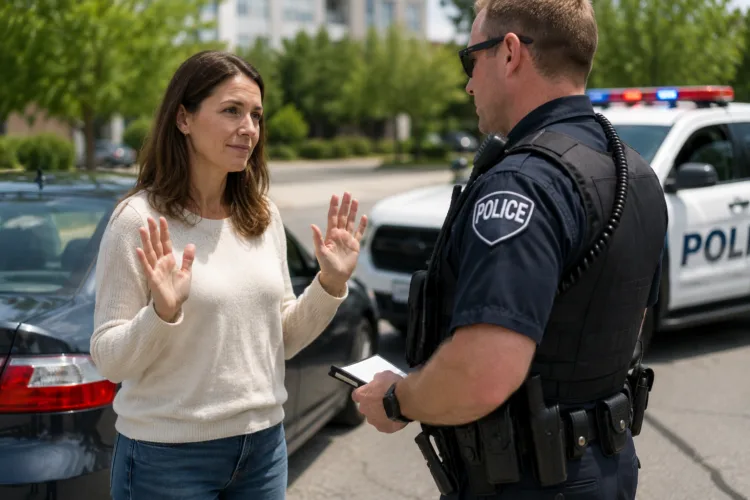
Be polite. This is not the moment to argue, resist, or lecture anyone about the Constitution. Hostility makes everything worse.
Comply with lawful requests. If you’re driving, hand over your license, registration, and insurance. You’re required to identify yourself. Beyond that, you are not required to answer questions.
Say this: “I’m not going to answer any questions without my attorney present.” Then stop talking. You don’t need to explain why. You don’t need to be apologetic about it. You just need to say it once and mean it.
Ask if you’re free to go. If the police say yes, leave calmly. If they say no, you’re being detained. Don’t leave. But also don’t keep talking.
Call a lawyer as soon as you’re allowed to. If you’re arrested and taken to the station, they must allow you to make a call. Use it.
Read Around — Then Give Us a Call

If your case is pending anywhere in Wayne, Oakland, Macomb, or the surrounding counties, my team and I would be glad to talk with you. All of our consultations are free, confidential, and done over the phone right when you call. We’re friendly people — you won’t feel judged for calling, and you won’t feel pressured.
This blog is a good place to start. It covers a wide range of criminal defense and DUI topics in plain language, and it’s fully searchable. Read around. Then call around. Compare what different lawyers say and how they explain things.
We can be reached Monday through Friday, from 8:30 a.m. until 5:00 p.m., at 586-465-1980. We also have an after-hours answering service, so don’t hesitate to call. You can also reach us through the contact form or chat box on our website. For more on what we handle, visit our Michigan criminal defense page.