


How to Avoid Jail Time for a 3rd DUI Offense in Michigan
How to Avoid Jail Time for a 3rd Offense DUI in Michigan
What You Need to Know
- A third DUI in Michigan at any point in a person’s life is a felony charge carrying a maximum potential penalty of up to five years in prison.
- The mandatory minimum is 30 days in jail — but that minimum can be waived.
- Admission into a Sobriety Court program can eliminate the jail requirement entirely.
- Three OWI convictions within 10 years results in a lifetime driver’s license revocation, with no appeal possible for at least five years.
- A Sobriety Court admission can unlock an override of that revocation and allow a restricted license.
- Our firm’s approach begins with a thorough review of the evidence — looking hard for a way out of the charge before considering how to minimize the penalties.
A 3rd offense DUI charge in Michigan is serious. It’s a felony, and the potential consequences — prison time, a lifetime license revocation, heavy fines and long, difficult probation — are real. Anyone facing this charge already knows that. What many people don’t know is that these consequences are not automatic, and that the outcome of a third-offense DUI case is shaped, more than anything else, by the quality of the legal work done on the front end.
This article is not a scare tactic listing of worst-case scenarios. It’s an explanation of how our firm approaches a third-offense case, why the fundamentals of DUI defense matter just as much here as they do in a first offense, and how we have kept clients facing felony DUI charges out of jail — even when the evidence against them was solid.
The Charge: What a Third-Offense DUI Actually Means in Michigan
The formal charge is Operating While Intoxicated (OWI), Third Offense, under MCL 257.625. Unlike a first or second offense, a third OWI is a felony. The potential penalties include:
- 1 to 5 years in state prison, or probation with a minimum of 30 days to 1 year in jail (unless a person is admitted to a specialty court program, like Sobriety Court)
- Mandatory community service of up to 180 hours
- Fines ranging from $500 to $5,000
- 6 points added to the driving record
- Vehicle plate confiscation and registration denial
- Driver’s license revocation — in most cases, for life, with no appeal for at least five years
That last point deserves emphasis. If the third OWI conviction occurs within 10 years of two prior OWI convictions, the Secretary of State will revoke the driver’s license, and that revocation cannot be challenged through a license restoration appeal for a minimum of five years. This is not a suspension — it’s a revocation, and it has to be taken seriously right from the start.
For a complete overview of third-offense penalties, the court process, and defense strategies, see our article Michigan 3rd Offense Felony DUI — Penalties & Strategies.
Why the Fundamentals Matter Most in a Third-Offense Case
There’s a tendency, when someone is facing a felony charge, to treat the case as fundamentally different from a misdemeanor — to assume that the stakes change the approach. They don’t. The foundation of every DUI defense, whether it’s a first offense or a third, is the same: examine all the evidence, look hard for problems with the stop, the field sobriety tests, the chemical testing, and the chain of custody, and determine whether there’s a path to getting the charge dismissed or, if not, then reduced.
Our firm handles DUI cases every week across Wayne, Oakland, and Macomb, and the surrounding counties. The cases that turn out best — including third-offense cases — are almost always the ones where the lawyer starts determined to find something wrong with it, rather than resigned to merely look over the evidence to see if anything “jumps out.” That means beginning the review with the firm belief that somewhere in the evidence, there is something that can be used to get the case dismissed.
That doesn’t change the facts, but the only way to find any such problem is to assume it’s there and look hard to find it. Even when the evidence is strong enough to withstand a legal challenge, that kind of close inspection often turns up things we can use to negotiate a better result.
A lawyer who approaches a felony DUI thinking the outcome is already fixed is going to miss things. Confirmation bias — following the police narrative instead of questioning it — is one of the most common ways good cases get lost. Our job is to examine every piece of evidence with the goal of finding a way out, and to keep looking until we’ve turned over every stone.
That means watching every frame of the dashcam and body-cam video, closely examining everything related to the calibration records for the breath testing instrument, the Intoxilyzer 9000 results and the circumstances surrounding the test, the field sobriety testing conditions, whether the traffic stop itself was legally justified, and anything else that touches on the reliability of the evidence the prosecutor intends to use.
How to Avoid Jail in a Third-Offense DUI Case
Even when the evidence is strong enough that the charge isn’t going to be dismissed, there are well-established paths to avoiding jail in a third-offense DUI case. Here are the two most important ones.
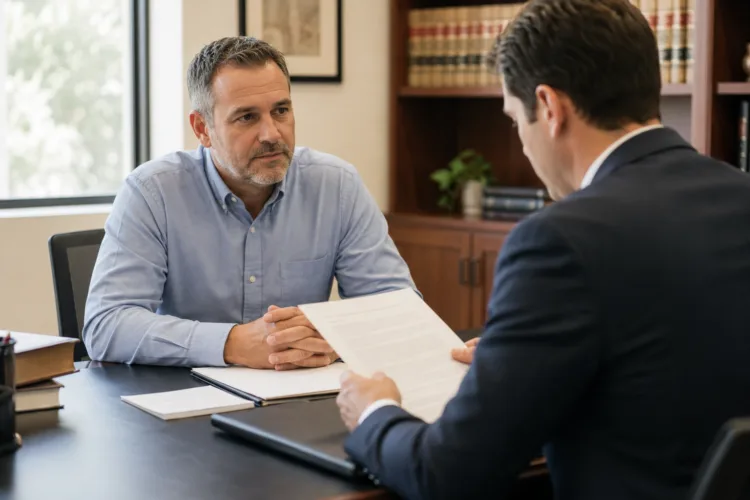
Plea bargain to a second-offense charge. In plenty of cases, it’s possible to negotiate a reduction from a third-offense felony down to a second-offense misdemeanor. A reduction to second offense not only eliminates the mandatory jail requirement entirely — it also significantly limits the damage to the client’s record.
Sobriety Court admission. The law that mandates a minimum of 30 days in jail for a third OWI conviction also contains an exception: that minimum can be waived if the defendant is admitted into a specialty court program. Sobriety Court is the most common of these programs. Our firm has extensive experience getting clients admitted into Sobriety Court, even across different jurisdictions.
We treat these applications as a top priority because the benefits extend beyond avoiding jail — a Sobriety Court participant can also receive a restricted driver’s license, which would otherwise be unavailable for years.
Our firm has handled many third-offense DUI charges where the evidence was solid, and we still kept our clients out of jail. That is not a claim about luck. Every one of those outcomes was the result of deliberate legal work — identifying the right strategy, preparing the right arguments, and doing the work necessary to protect our client’s freedom and interests.
A Note on the Lawyer’s Mindset
This may sound like an unusual thing to include in a legal article, but the mindset of the lawyer handling a third-offense DUI case is genuinely important — not as a matter of marketing, but as a matter of legal strategy.
A lawyer who starts from the assumption that a felony DUI is a losing battle is going to approach the evidence differently than one who starts from the assumption that there IS a way to improve the outcome. The former will look for confirmation that the charge is valid. The latter will look for the things that can be challenged and a way to get the charge dismissed or reduced.
Our job is to save your freedom. That means we approach every third-offense case — regardless of how strong the initial evidence appears — with the determination to find something useful, pursue every available avenue, and put you in the best possible position before you ever set foot in a courtroom.
Frequently Asked Questions
Will I Do Mandatory Jail Time for a Third DUI Conviction in Michigan?
Not necessarily. The law requires a minimum of 30 days in jail for a third OWI conviction, but that requirement can be waived entirely if you are admitted into a specialty court program such as Sobriety Court. Beyond avoiding jail, Sobriety Court participants can also receive a restricted driver’s license with an ignition interlock device — driving privileges that would otherwise be unavailable for at least five years.
Our firm has unmatched experience handling Sobriety Court admissions and treats them as a top priority. Getting a client into the right program at the right time can change everything about a third-offense outcome.
What Are the Possible Defenses in a Third-Offense DUI Case?
The defenses are the same as in any DUI case — they just carry higher stakes. A thorough review of all the evidence can reveal problems with the initial traffic stop, the field sobriety testing, the Intoxilyzer 9000 results, or the blood draw procedures. Any of those problems can give rise to challenges that result in a dismissal or a reduction of the charge.
When the evidence doesn’t produce grounds for a dismissal, the focus shifts to negotiating the best possible outcome — whether that’s a plea bargain to a lesser charge, an admission into Sobriety Court, or a sentence agreement to protect your freedom.
Is a Third DUI a Felony or a Misdemeanor?
A third-offense DUI at any point in a person’s life is a felony in Michigan. One of the primary goals in cases where the evidence is solid is to negotiate a reduction to a second-offense misdemeanor. That outcome eliminates the mandatory jail requirement and is significantly better for the client’s criminal record.
Can Hiring a Lawyer Help You Avoid a Felony Conviction?
Yes — and it can also help avoid jail, reduce fines, preserve driving privileges, and limit the long-term damage to your record. A third-offense DUI is a serious charge, but it is not an automatic conviction, and it does not mean you face an automatic felony conviction. The outcome depends heavily on the quality of the legal representation and the work done before the case ever reaches a courtroom.
Talk to Our Office — Free, Confidential Consultation
If you or someone you know is facing a third-offense DUI charge in Wayne, Oakland, Macomb, or the surrounding counties, our firm is available to help. We offer free consultations by phone, Monday through Friday from 8:30 a.m. to 5:00 p.m. An answering service is available after hours. Call us at 586-465-1980. You can also reach us through the contact form or chat on our website. For more information about our DUI defense practice, visit our Michigan DUI defense page.