
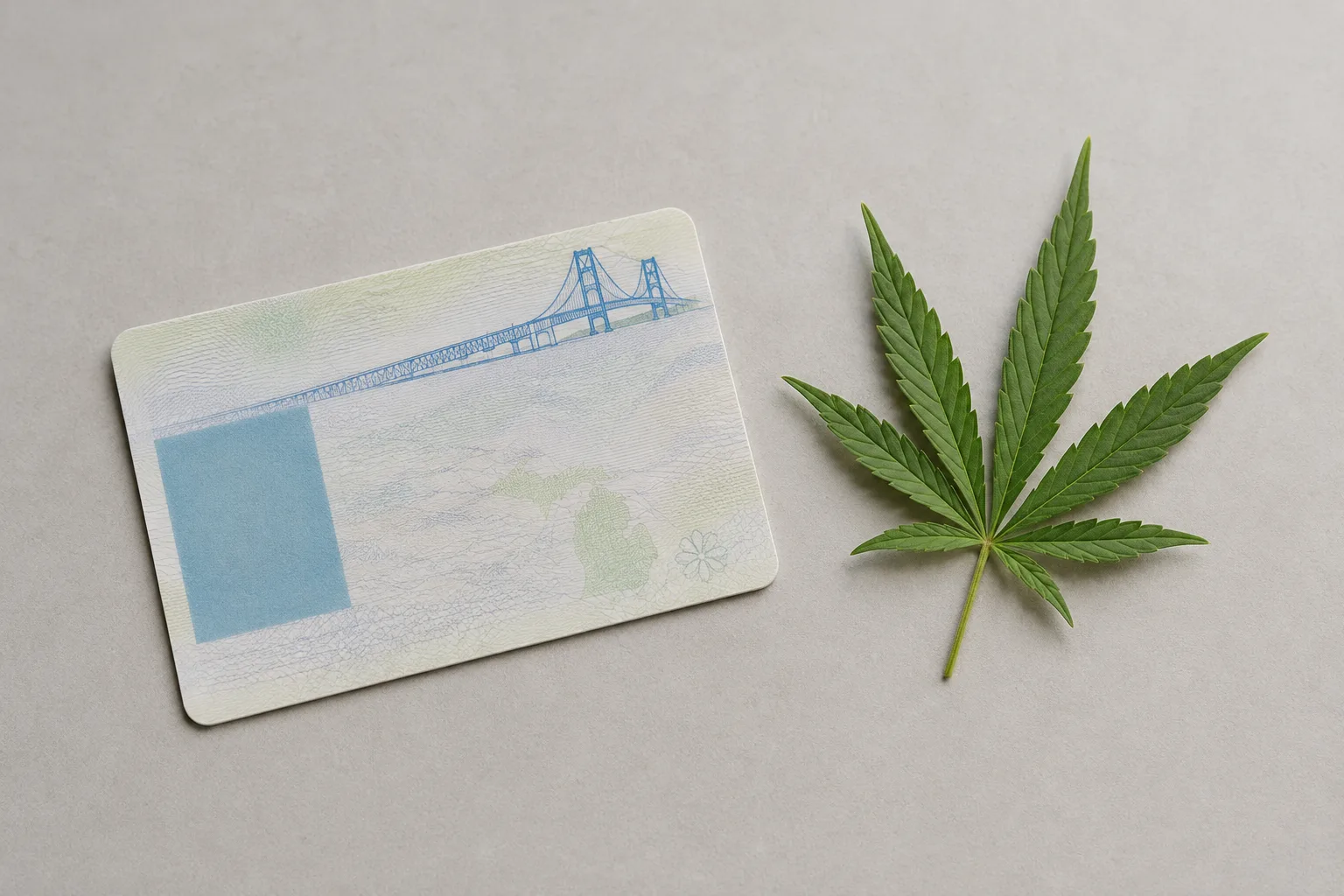

Marijuana and Michigan Driver’s License Restoration
What You Need to Know
- Using marijuana — recreational or medical — is a serious obstacle to winning a Michigan license restoration or clearance appeal.
- Michigan law requires proof of complete abstinence from alcohol and all other substances, including marijuana.
- Recreational marijuana is a 100% bar to winning. Medical marijuana use faces strict requirements and is rarely permitted.
- Sobriety means not using any mind-altering substance — it does not mean simply switching from alcohol to marijuana.
- Our firm generally requires at least 18 months of complete sobriety before moving forward with any case.
- The hearing officers who decide these cases are experts at detecting dishonesty. There is no way to BS your way through.
My team and I spend most of our time handling driver’s license restoration and clearance appeal cases. In any given week, we’ll screen a significant number of people who call us about getting their driving privileges back. If we could take every case from everyone willing to pay, we’d be turning away very little work. The reality, however, is that one of the most common reasons we can’t move forward with a case right now is marijuana.
Ever since recreational marijuana was legalized in Michigan in 2018, it has become a genuine crisis in the license restoration world. People who have finally managed to quit drinking will often take up marijuana, seemingly without realizing — or accepting — that it creates the exact same problem. From our perspective as Michigan driver’s license restoration lawyers, the legalization of recreational marijuana has required more explaining than almost any other single issue we face.
This article addresses that problem head-on.
License Appeals Are About Sobriety — All of It
The most foundational principle of any Michigan driver’s license restoration or clearance appeal is sobriety. Not reduced drinking. Not controlled use. Complete, permanent abstinence from alcohol and all other mind or mood-altering or potentially habit-forming substances.
When someone’s license has been revoked after accumulating two or more DUI convictions, the state has concluded that person is a demonstrated risk. More on this later.
This means that all license appeals start with the presumption that the person does, in fact, have a problem. Michigan law makes clear that anyone in that position cannot get their license back until they prove two things: that they no longer drink or use any other substances, and that they are committed to living that way permanently.
People who no longer drink — and who genuinely embrace sobriety in its full meaning — are the safest possible bet to put back on the road. They are also the only people the law allows to be reinstated after a revocation for multiple DUIs.
What the Law Actually Says
The main rule governing Michigan Secretary of State driver’s license restoration appeals is Rule 13. Here is the relevant language:
The hearing officer shall not order that a license be issued to the petitioner unless the petitioner proves, by clear and convincing evidence, all of the following:
i. That the petitioner’s alcohol or substance abuse problems, if any, are under control and likely to remain under control.
ii. That the risk of the petitioner repeating his or her past abusive behavior is a low or minimal risk.
iii. That the risk of the petitioner repeating the act of operating a motor vehicle while impaired by, or under the influence of, alcohol or controlled substances or a combination of alcohol and a controlled substance or repeating any other offense listed in section 303(1)(d), (e), or (f) or (2)(c), (d), (e), or (f) of the act is a low or minimal risk.
iv. That the petitioner has the ability and motivation to drive safely and within the law.
v. Other showings that are relevant to the issues identified in paragraphs (i) to (iv) of this subdivision.
What That Means in Plain English
Here is what a person filing a Michigan license restoration or clearance appeal needs to understand from that rule:
- Under Michigan law, anyone whose license has been revoked for multiple DUIs is legally categorized as a “habitual alcohol offender” and is presumed, by law, to have an alcohol and/or substance abuse problem.
- The hearing officer is directed to deny the appeal unless the evidence submitted is “clear and convincing.” That is a high standard — it means the evidence must be persuasive enough to produce a firm belief that what is claimed is true.
- A person must show that their alcohol and/or substance abuse problem is “under control.” This means proving complete abstinence from alcohol and all other substances — including recreational marijuana — for a legally sufficient period of time. Our firm generally requires at least 18 months of clean and sober time before moving forward.
- A person must also prove that their problem is “likely to remain under control.” This means demonstrating both the ability and the commitment to never drink or use any other substance — including recreational marijuana — again. The person must show they are a safe bet to remain clean and sober for the rest of their life.
That last point deserves emphasis. The law carries a presumption that anyone who has had their license revoked for two or more DUIs has a substance abuse problem. In the clinical world, it is accepted as fact that a person cannot be in genuine recovery from a drinking problem while still using marijuana recreationally. The two are mutually exclusive.
Why “But It’s Legal” Doesn’t Help
The most common objection we hear is some version of “But marijuana is legal now!” We understand the frustration behind that argument. But consider this: drinking is also legal. And any use of alcohol — even a single drink — will end a license appeal just as surely as a relapse.
License restoration cases are not about what is legal in the general public. They are about whether a specific person, who has been legally categorized as a habitual alcohol offender, has genuinely addressed their substance abuse problem. Legality is not the standard. Sobriety is.
Think of it this way: someone who had a serious gambling problem and lost everything at the casino has not solved their problem by switching to the racetrack. The activity changed; the underlying compulsion did not. The same logic applies in recovery from alcohol or substance abuse. Switching from alcohol to marijuana is not sobriety — it is substitution.
It does not matter what we or anyone else may think about marijuana personally. The law is what it is, and a hearing officer is not going to make an exception because someone believes their situation is different. No one is going to walk into a hearing and successfully argue that, despite the law’s requirement to prove abstinence from all substances, marijuana should be treated as a carve-out. It will not happen.
What Sobriety Actually Means in This Context
In the context of a Michigan license restoration case, sobriety has a specific, clinical meaning. It is the choice to permanently refrain from the use of any and all intoxicating, mood or mind-altering, or potentially habit-forming substances. This is not a standard unique to Michigan license law — it is the mainstream position of the addiction treatment community.
You do not need to be in AA to win a license appeal. But those who have spent real time in recovery — through AA, counseling, or any serious treatment program — have heard the warnings about substitution many times. Being sober means not altering one’s consciousness. It does not mean just switching the substance used to do that.
A person who genuinely understands what recovery means knows they cannot use recreational marijuana. If someone does not understand that, it suggests they have not yet fully grasped what sobriety requires — which is itself a problem for a license appeal.
Medical Marijuana Is a Separate — and Complicated — Issue
Recreational and medical marijuana are treated differently in the license restoration context, though neither one is simple. We have won cases for clients who use medical marijuana, but only under very strict and specific conditions.
To even be considered, a person using medical marijuana must demonstrate that there is no other suitable medical alternative for a serious health condition. That documentation must come from a treating physician — not a doctor seen one time at a “green clinic” just to obtain a card. The physician must know the patient’s substance abuse history, must be actively monitoring the patient’s use, and must provide documentation that is regularly updated.
The bar is high, the documentation requirements are substantial, and the margin for error is extremely narrow. Medical marijuana cases require careful, experienced handling. For a deeper look at how these cases work, see our article on winning a Michigan license restoration case with a medical marijuana card.
Recreational marijuana, by contrast, has no exceptions and no workarounds. It is a complete bar — period.
The Hearing Officers Know What They’re Doing
Some people figure they can simply say they don’t use marijuana and move forward. That approach has several serious problems.
First, it misses the point entirely. Someone who would even consider lying about their sobriety is demonstrating exactly the kind of mindset that disqualifies them. A person who is genuinely committed to sobriety does not need to hide anything. The willingness to be dishonest about substance use is itself evidence that the underlying problem has not been resolved.
Second, the hearing officers who decide these cases are not easily fooled. They hear appeals every day. They expect people to minimize or misrepresent their substance use. A significant part of their job is testing the quality of a person’s claimed sobriety — probing for inconsistencies, asking follow-up questions, and evaluating whether the account of recovery holds together under scrutiny.
We screen every potential client carefully before we agree to take a case. We ask direct questions about alcohol and drug use, and we need honest answers. Our firm guarantees to win every restoration and clearance case we take — but that guarantee is built on having a client who is genuinely clean and sober. It is not built on wishful thinking, and it is not something we will extend to someone who is not ready.
The Bottom Line
Recreational marijuana and a Michigan driver’s license restoration or clearance appeal cannot coexist. A person can have one or the other — not both.
We realize that marijuana is not a hardcore drug, and we have heard every argument for why someone uses it. We are not here to pass moral judgment on anyone. But what we think — or what anyone thinks — does not change the law.
Unless a person can demonstrate that they do not and will never drink or use any other substances, including recreational marijuana, there is no path to winning a Michigan license restoration or clearance appeal.
If you have stopped drinking and you are not using marijuana or any other substances, and you have been genuinely clean and sober for at least 18 months, we want to hear from you. If not, let’s talk, and maybe we can help you see things differently so you can get there.
Call Us — We’ll Tell You Exactly Where You Stand
Our firm handles driver’s license restoration and clearance cases statewide and for clients living outside of Michigan. All consultations are free, confidential, and done over the phone. We’ll give you honest answers about where you stand and what your realistic options are — without sugarcoating.
We’re available Monday through Friday, 8:30 a.m. to 5:00 p.m. After-hours calls are answered by our answering service. You can also reach us through the contact form or chat box on our website.
Call us at 586-465-1980. We’re ready when you are. For more information about the license restoration process, visit our Michigan driver’s license restoration page.