

Understanding Michigan Court Proceedings For Probation Violations
In part 2 of this article, we continued our inquiry into probation violation cases in Michigan criminal and DUI cases. In particular, we tried to see how the whole violation thing is perceived by the Judge who sentenced you for a drunk driving offense or something like a drug (including marijuana) crime. We also noted that although positive test resultsare the most common reason for being violated, missed testscome in a reasonable close second, with false-positive results a distant third. Here, in our 3rdand final part, we’ll go into the courtroom itself and see how it is proven that a person has violated his or her probation and how that plays out in front of the Judge.
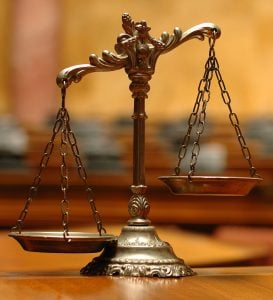
Up to this point, we’ve looked at the 3 most common reasons that give rise to a probation violation: A positive result, a missed test, and a false-positive result. Now, let’s look at how these are handled in court and what must be shown to prove that there was, in fact, a violation. That “showing” is technically called the “standard of proof.” Everyone knows that if you’re accused of a crime and go to trial, the prosecutor must prove your guilt beyond a reasonable doubt. A probation violation is proven by a much lower standard, called a “preponderance of the evidence.” The most common way this is explained is to imagine the scales of justice sitting even, or level. As soon as you put something on one tray, it goes down and the empty side goes up. Now, if you put something of equal weight in the other tray, the scales go back to even and level. If you put something that weighs just a little more on one side than you do on the other, then the heavier side falls farther down, and the lighter side remains higher. Surely you get this. A preponderance of the evidence means just enough evidence to tip the scales from being exactly even, one way or the other.
Let’s consider an example: Assume that Sneaking Sam has missed atest. Now, picture the Judge on the bench, with the scales of justice next to her, and they’re level (even). She looks at Sam and says, “I have a notice that you missed a test last week, Sam.” She then grabs a 5-pound weight and puts it on one of the scales, causing it to tip. So far, the preponderance of the evidence weighs in favor of Sam having missed his test. Next, the Judge asks what Sam has to say, and his lawyer explains that Sam’s boss called him in early the day of the missed test because there had been a flood at the workplace, and hands up a letter from the boss to that effect. The lawyer also offers up a make-up EtG test taken the next day. The Judge then takes a 2-pound weight for the letter and a 2-pound weight for the make-up test and puts them on the other scale, causing the missed test side to rise. Still, the scale hangs a bit lower on the side of the missed test. That’s because the preponderance (think of it as the majority) of the evidence supports the idea that Sam did, in fact, miss his test. Sure, he has a relatively good reason for doing so and it’s true that he has a clean make-up test, but in terms of the simple allegation that he missed the test, Sam’s evidence does not outweigh that on the “missed” side.
Consider another example, and this one will go in Sam’s favor. Assume that he is called in for a violation due to a positive test result for marijuana. Suspecting that something was up with the testing facility, Sam left it and went directly to a lab and had a blood test done for $100. When he gets to court, the Judge tells Sam she has a report of a positive test for marijuana, and then reaches over and puts a 5-pound plate on the one scale, tipping it decidedly in favor of a violation. Sam’s lawyer then hands up the much more reliable and sophisticated blood test, and explains that the testing facility is kind of dumpy and has a constant turnover of “questionable” employees, but recently has had an entire lineup of new people there who didn’t have a clue what they were doing. The Judge reaches over and takes a 7-pound weight and puts in on Sam’s side of the scale, tipping it back in favor of him NOT having used marijuana, in part because Sam’s $100 blood test is much more reliable than the $25 EtG urine test taken at the testing facility.
These examples are extremely simplistic, but before we put them away for good, imagine in each of them that instead of a letter and a make-up test or a confirmatory negative test, Sam had nothing more to offer for evidence other than a very vocal insistence that, in the first case, he didn’t miss the test, and in the second case, that the positive result was just plain wrong. How much “weight” do you think any Judge would assign to that? How about none? Hang on to your hat for a bit, because this will seem to get a bit worse before, as we’ll see, it does get better.
Whether anyone agrees with the whole concept of testing or not, and whatever he or she may think about the appropriateness and reliability of it all, it is what it is. You’resentencedto probation and you have to test. That means showing up at a dingy, dirty place and paying too much to blow into a machine or pee in a cup; it is what it is. The results obtained from this process are not the gold standard of scientific accuracy, but they are what the Judge expects and works with to make sure you’re not drinking or using anything. False positives are, far and away, the exception. Missed tests will always raise red flags, and, even if a person produces a clean result for the time frame of a missed test, there’s still the failure to test when required (missed test) that is at issue.
People who are drinking tend to fail tests, and they miss a lot of them, too. When you’re facing a probation violation, the weakest evidence is a simple denial, but in the real world, that’s often the only evidence a person has. When it’s put like that, it sounds pretty weak. Yet, in the real world, that is, in the world that tells us “When life hands you lemons, make lemonade,” you can either give up because your evidence seems, at first glance, rather thin, or you can stand tall and stand your ground. Although we never say it like that directly to the Judge, sometimes we need a little of that, “This is bull$hit!” attitude. To be clear, I mean we need to capture a little bit of that indignation – that lightening in a bottle – that only comes when an innocent person is falsely accused of something he or she didn’t do. Here’s how all that goes down, procedurally, in court.
A probation violation proceeding usually begins with an arraignment, where a person is informed of the alleged violation and is given a chance to plead. Here’s some free advice that’s priceless: Unless you’re standing next to your lawyer, and he or she instructs otherwise, you ALWAYS plead “not guilty.” There is no exception to this, either. I think the reader may indulge me a bit here and not think I’m being condescending if I point out that in this situation, it’s best to let the experts handle things. One might say that, if you’re standing in front of a Judge for a probation violation, and even if you have a great explanation for it, you’re clearly not on any kind of a lucky roll, anyway. Therefore, when you’re in court without counsel, you should plead not guilty and get a hearing date so you can come back with your lawyer. By law, unless you waive the time frame on the open record (some courts will do this, others won’t), your violation hearing date must take place within 14 days from the date of your arraignment.
In some courts, a probation officer will be there for your hearing. In other courts, he or she will have submitted a written notice of your violation and also a recommendation as to what sanction (punishment) you should receive. In the real world, most probation violations are resolved by a plea, and not after an actual hearing, which is kind of like a mini-trial where the rules of evidence DO NOT apply. Think of a missed test; whatever the reason for the miss, no one really demands a hearing to try and prove that he or she really did show up and provide a breath or urine sample. If you missed, you missed. For the most part, even if there is some type of “hearing,” to be held, it usually does not involve calling witnesses. Even in a false-positive situation, most people will present their evidence without grilling the lab tech people from the testing facility. Of course, there are exceptions, but we’re talking about how most cases proceed; yours could very well be an exception.
Some courts have a certain “day” of the week set aside for probation violation hearings, while another may do them several days per week, or handle them as they come up. Whatever the schedule, a person will report to court on the chosen date with his or her lawyer. In some courts, it is expected that the lawyer will first meet with the probation officer (I prefer this) before ever going in front of the Judge. Other courts don’t do it quite that way, but are open to some kind of pre-hearing meeting taking place between the lawyer and the probation officer. For my part, I always try and meet with him or her anyway.
At some point, though, you will be in court with yourlawyer. The Judge will call the case, and you will be told exactly what you are alleged to have done wrong, or otherwise not done that you should have. The Judge will ask your lawyer how you wish to proceed. At this point, the lawyer will either explain that he or she wants a full hearing (this sometimes requires a return date if essential witnesses need to be brought into court) or is ready to enter a plea. As I noted before, the vast majority of cases are resolved with a plea. In a recent case I mentioned above, I replied to the Judge that my client was going to plead guilty to the fact that his urine test came back positive, but that we were going to explain that the result was incorrect. For all the stuff I’ve written about knowing the Judge, I had extensive experience with the particular Judge hearing that case, and wasn’t surprised when, as I told him that and added, “I know you love it when lawyer do this, Judge,” he chuckled. I would not have proceeded that way, however, in front of the Judge who has zero interest in why a person tested positive. In other words, the right way to proceed in one court may be the wrong way to proceed in another.
Once the lawyer indicates that you’ll be pleading guilty, you’ll be asked to raise your hand and be sworn. You will then be asked questions by the Judge, although sometimes, a Judge will let the lawyer ask the questions to make the record. Thus, if Dizzy Denise is sworn in a probation violation involving a missed test, the Judge will ask something like, “is it true that on July 2 (or whatever date) you failed to show up for and provide a breath (or urine) test?” All that’s required for the plea is that Denise answer, “Yes.” At that point, the plea has been taken and then the Judge looks for more information, an explanation really, to be considered before he or she imposes sentence. This is technically called “allocution.” In those cases where a probation officer is in the courtroom, the Judge will ask for his or her input, as well. Usually, when a probation officer is in the courtroom, he or she will also offer up a recommendation as to what should happen (extend probation, put the person on tether/alcohol tether, increase testing, extend probation and/or give some jail time, etc.). When a probation officer is not in the courtroom, there is usually a written report that contains that sentencing recommendation, instead.
Now, for everything I’ve written, you have to understand that all these things just have a “feel” about them. This ties into that whole “instinct” thing I mentioned earlier. In that sense, it’s like trying to explain what surgery is like by saying that you get knocked out, cut open, fixed, sewn back up, sent to recovery, and then you go home and get better. While that does cover the basics, it falls far short of the actual experience. It is understandable that a person will be as nervous for a probation violation as he or she may be about surgery, because they are both “unknowns” to the person about to go through it. As I observed before, nobody comes into a probation violation on a roll. Still, I hope this article has helped me explain things somewhat. I know that this kind of article will appeal to those with more of an “inquiring mind” rather than someone who wanted short answer, but I figure they dropped off long ago, in part 1. This whole “explaining things” is, however, an important consideration as youlook for a lawyer. If you’ve read this far, you’re probably NOT interested in the lawyer who is frugal with analysis and discussion. Keep that in mind as you read articles like this and check out various lawyer’swebsites. And as much as I have tried to explain here, I know that there will always be questions I haven’t even touched upon.
If you’re looking for a lawyer for a probation violation in the Detroit-area, meaning in any court in either Macomb, Oakland or Wayne County, call around and make sure you callmy office, as well. My fees are reasonable for the level of skill and experience I bring, and my phones are answered Monday through Friday, from 8:30 a.m. until 5:00 p.m., at 586-465-1980. All consultations are done over the phone, right when you call, so answers to your questions are just a call away. We’re here to help.