

Do I Need a Lawyer for a Driver’s License Restoration Appeal?
Key Takeaways
- No law requires a lawyer for a Michigan license restoration appeal, but you must overcome a legal presumption of a substance problem by clear and convincing evidence before a hearing officer who is an attorney handling these cases daily.
- Cases often fail on documentation gaps, such as inconsistencies between your evaluation and testimony, vague support letters, or a drug screen that isn’t a 12-panel lab test.
- A denial means waiting a full year to refile, and circuit court appeals rarely succeed, so a well-prepared first attempt matters.
- A Michigan hold follows you out of state, but hearings are held remotely by video, so you can resolve it from anywhere.
Technically, no — there’s no law that requires you to hire an attorney for a Michigan driver’s license restoration appeal. But here’s the reality: the hearing officer who decides your case is a licensed attorney who handles these files every single day, and the evidence standard is demanding. Under Michigan law, anyone with multiple DUI convictions is legally presumed to have an alcohol or substance abuse problem. To win, you have to overcome that presumption by clear and convincing evidence. That’s a high bar.
A denial costs you a full year before you can try again. That’s not a technicality — that’s another year without a license. A license restoration lawyer in Michigan can make the difference between winning now and waiting another year.
Having a driver’s license restoration lawyer on your side can mean the difference between getting your life back now or much later.
Do You Actually Need a Lawyer for Your OHAO Hearing?
No law requires it. The license restoration process is administrative — not a criminal proceeding — and there’s no right to appointed counsel if you can’t afford one. But what you’re filing is not a simple form. It’s a formal legal appeal with a real (and high) burden of proof.
To win, you have to show by what the law specifies as “clear and convincing evidence” that your legally presumed alcohol or substance problem is genuinely under control and likely to remain that way. That means submitting:
- A completed Substance Use Evaluation from a licensed evaluator
- A 12-panel lab urinalysis — instant tests are not accepted
- Multiple letters of support from people who know your situation and can speak directly to your sobriety
Each of those documents can and will be questioned. The process may look manageable on paper. In practice, however, even small documentation gaps, inconsistencies between your evaluation and your hearing testimony, or a drug screen that doesn’t meet the requirements are among the most common reasons these cases fail.
One thing worth understanding: a revoked license is not the same as one that has merely been suspended. A suspension typically resolves with time and fees.
Revocation requires a formal appeal through the Office of Hearings and Administrative Oversight (OHAO) — and if you lose, you wait a full year before you can go back.
If you lost your license after multiple OWI convictions, there’s a mandatory wait before you can even request a hearing. One year is the legal minimum. But that’s rarely the real timeline.
If you were on probation or parole at any point, that time doesn’t count — the law treats incarceration, probation, and even a sober house as a “controlled environment,” and sobriety maintained under those conditions isn’t given the same weight as sobriety that was maintained freely, on your own. The period of voluntary sobriety that counts — and how long it needs to be — depends on your individual history, including any relapse history.
For most people with two convictions within seven years, all of that pushes the realistic timeline to something closer to three years. Three convictions within ten years means a five-year wait before you can even request a hearing — which makes a well-prepared first attempt critically important.
Who Actually Decides Your Michigan License Restoration Case?
The hearing officer is a licensed attorney employed by the Michigan Secretary of State. They are called “administrative law examiners.” Their job is to evaluate whether your evidence meets the legal standard set by law.
The most common reasons they deny cases:
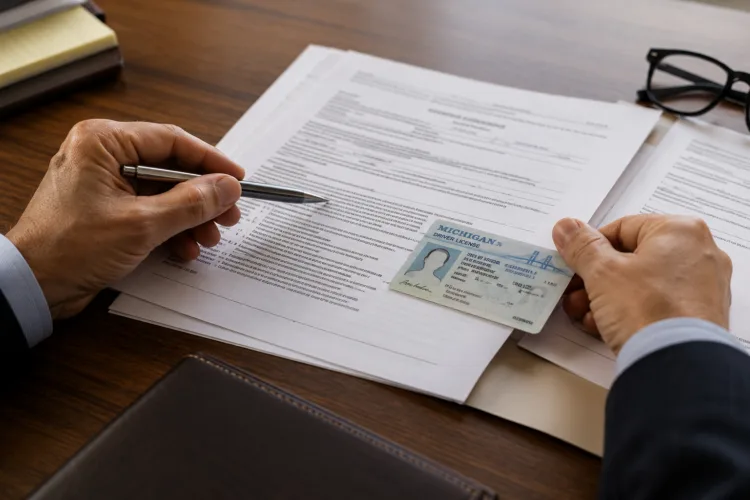
- Inconsistencies between what the Substance Use Evaluation says and what you say at the hearing
- Minimizing or glossing over your history with alcohol or other substances
- Support letters that are vague, generic, or don’t directly address your sobriety
- A drug screen with the wrong panel count or done as an instant test instead of a lab test
We’ve said it before and it bears repeating: what sobriety means under Michigan’s restoration standards is not just “I stopped drinking.” It means demonstrating a genuine, lived change — in your habits, your relationships, your daily life — in a way that holds up under scrutiny from an examiner who reviews these cases for a living.
We’ve worked with plenty of people who were absolutely, genuinely sober and still lost their first “do-it-yourself” attempt (or with some lawyer whose practice didn’t concentrate in these cases) because the documentation didn’t meet the required level of proof. That gap — between “I’m sober” and “I can prove it” — is where most self-represented cases fall apart. It’s the single most important reason to work with a license restoration lawyer in Michigan before you file.
What Happens If Your Michigan License Restoration Appeal Is Denied?
A denial at OHAO gives you two options: wait a year and file again, or appeal to circuit court. You have 63 days to file a circuit court petition, or 182 days if you can show good cause.
At circuit court, you’re no longer dealing with just a hearing officer. The State of Michigan sends an assistant attorney general to defend the original decision. Their job is to argue against you — and they’re good at it. The circuit court’s standard of review is narrow: it can only overturn the decision if it was arbitrary, capricious, or a clear abuse of discretion. Most circuit court appeals don’t succeed. That’s another reason why bringing a license restoration lawyer in Michigan into the process before the first hearing — not after a denial — makes such a difference.
There’s also a timing issue worth understanding. The one-year window to re-petition OHAO runs from the date of your original OHAO denial — not the date of any circuit court ruling. If the circuit court process drags on and you lose, you may have burned significant time and money and still be no closer to restoration than if you’d simply waited.
For a closer look at exactly what a denial means and what your options are afterward, see our article on what it means to lose a Michigan license restoration appeal.
Does a Michigan License Hold Follow You If You Move Out of State?
Yes. If you used to live in Michigan, had your license revoked after a DUI/OWI conviction, and moved to another state — or another country — that Michigan hold is still sitting on your record. No state will issue or renew a license while a Michigan revocation is unresolved. International licensing authorities often have the same problem.
The good news is that you don’t have to come back to Michigan to fix it. All OHAO hearings are conducted remotely via Microsoft Teams. Our firm has represented clients in other states and other countries who resolved their Michigan hold entirely by video — some hadn’t set foot in Michigan in years. Wherever you are, Michigan driver’s license restoration is available to you.
Ready to Get Your Michigan License Back?
Wherever you are — across Michigan or somewhere else entirely — the first step is a conversation. All of our consultations are free, confidential, and done over the phone, right when you call. Contact our office at 586-465-1980 — we’re available Monday through Friday, 8:30 a.m. to 5 p.m., and there’s no pressure and no obligation.
You can also reach us online.
We back every license restoration and clearance appeal with a straightforward guarantee: we win your case the first time, or we keep representing you at no additional attorney fees until we do. You can read the full details on our guarantee page.
Contact Us Today