
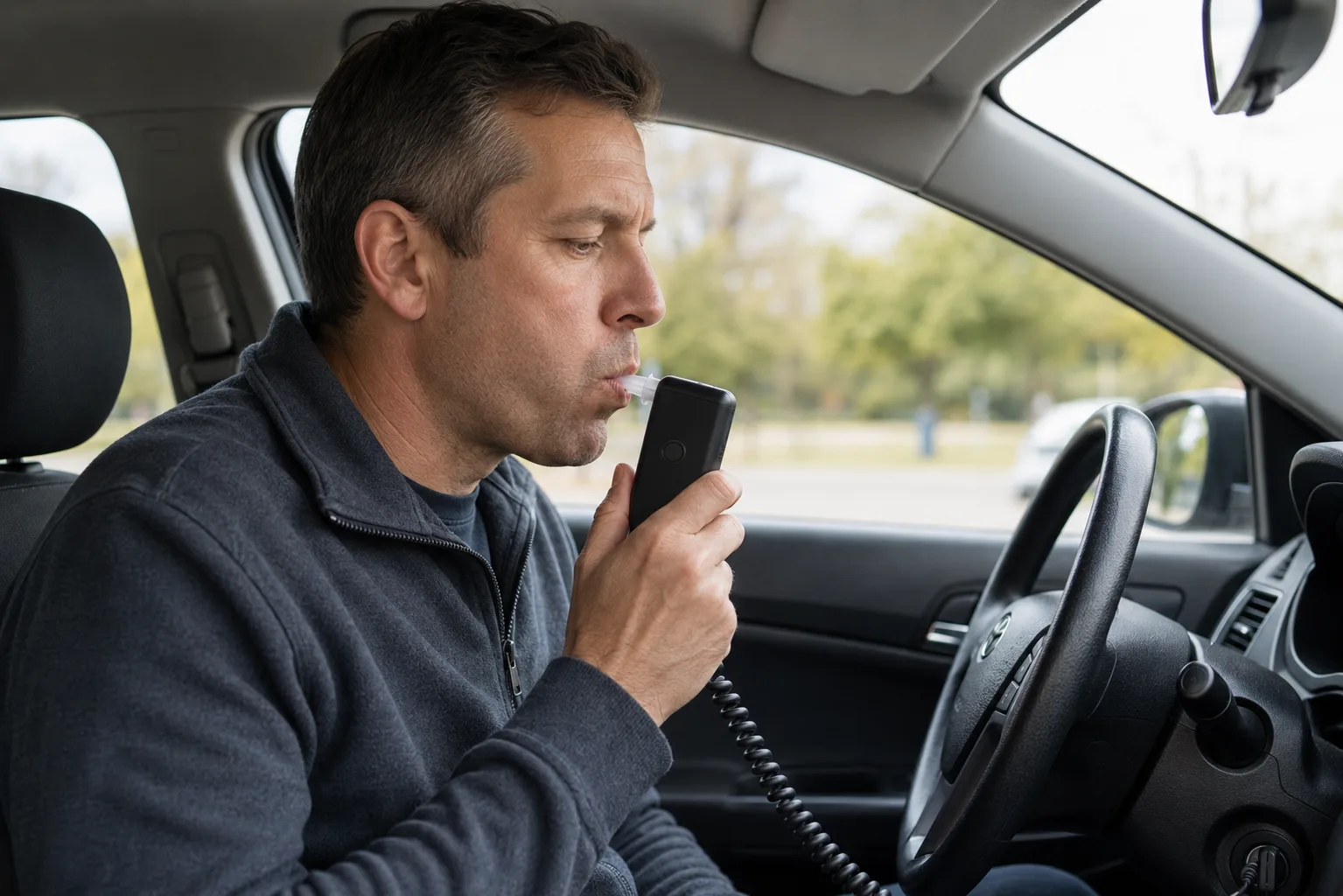

Ignition Interlock Violation in Michigan — What’s Next
In our roles as Michigan driver’s license restoration lawyers, we handle a lot of ignition interlock violation cases. We regularly save people from having their licenses permanently revoked. Many interlock violations seem unnecessary, and indeed, some really are unfair. However, there are also others that arise because a person does, in fact, test positive after having consumed beverage alcohol. In other words, they get caught drinking. Those situations are, by far, the worst. In this article, we’ll explore how to best handle an ignition interlock violation.
What Triggers an Ignition Interlock Violation
First, it’s important to understand that when our firm is hired to get someone out of an ignition interlock violation, we have to do a lot more than just show how or why it’s wrong. In fact, that’s often the easiest part of handling a violation case. A notice of ignition interlock violation provides, among other things, the date when the person’s license will be revoked again. Before a hearing date arrives, the person’s license will already be gone. The point of a violation hearing is about getting it back, but the whole process involves a lot more than just that.
Rather than grumble about how much this whole situation can feel unfair, we’re going to focus on fixing it. To be sure, the Secretary of State’s entire interlock system could be revamped so that simple interlock mistakes could be more easily rectified. However, as the old saying goes, “it is what it is.” All the complaining in the world isn’t going to overturn a pending ignition interlock violation. Instead, we have to do what’s necessary to win.
That begins by understanding both the finer and more general points of an ignition interlock violation.
When a person is granted a restricted license requiring use of an ignition interlock (technically called a “BAIID,” for “Breath Alcohol Ignition Interlock Device”), certain rules apply. He or she must do certain things, and cannot do others, as a condition of having restricted driving privileges. In that sense, having to use an ignition interlock is very much a probationary step to regaining full driving privileges.
The Michigan Secretary of State includes instructions in every order granting a restricted license, found in the section entitled “Notice of Proper Ignition Interlock Use.”
By far, the most critical and non-negotiable condition is that a person NOT consume any alcohol. For as important as that is, it is not the end-all of what’s required. For example, the rules also mandate that a person provide a timely breath sample when prompted by the interlock unit. Of course, the fear is that if someone skips a test, it’s because he or she has been drinking. However, even when a violation for a skipped rolling retest can be shown to NOT involve any drinking, that, by itself, doesn’t excuse the missed test.
There can be a good reason for something like missing a rolling retest, and in a perfect world, there would be a much simpler way to explain why — one that would avoid an automatic ignition interlock violation and the re-revocation of one’s license. But we have to work within the law and rules as they exist.
Here’s another real-life situation that frequently arises: A person gets violated for something like a “Tamper/Circumvent” because his or her battery died, and they can show they replaced it. Similarly, a “Tamper/Circumvent” violation can occur when someone has work done on his or her vehicle and the shop manages to create a problem because they didn’t properly coordinate with the interlock company.
This is certainly frustrating, and can be downright unfair. But either a person is going to fight the ignition interlock violation, or just let their license stay revoked.
The Worst Case: Testing Positive After Drinking
The worst situation, by far, occurs when a person does drink and then tests positive on the interlock. This most often happens when someone thinks they can “time” their drinking — figuring that by the time they have to blow into the interlock, they’ll be clean. This frequently takes place when someone drinks at night and assumes everything will be fine in the morning. What happens, though, is that things don’t work as planned, and they end up with a positive test on the interlock and a very real problem.
Here’s the most important advice we can offer:
DON’T DRINK!
Seriously. Not to be indelicate about it, but talk about playing with fire. First of all, anyone who won a license appeal convinced the hearing officer that he or she had quit drinking and was a safe bet to never drink again. Anyone on an interlock is supposed to be committed to an alcohol-free — and drug-free — lifestyle.
The whole point of the interlock is to monitor that commitment and make sure a person follows through. If someone goes out and drinks — even once — and then gets caught, the interlock did its job. Anyone in that situation is in serious trouble, and there isn’t a lot of sympathy from anyone, including our firm.
Our firm will NOT take an ignition interlock violation case if a person has admittedly been drinking. We’ll defend a false alcohol reading with everything we have, but that’s a very different situation than when a person simply gets caught drinking.

As noted, there are people who will overdo it at night and think they’ll be fine by morning. Then they go out the next day and the vehicle won’t start because their breath alcohol level is still too high. If such a person continues to provide breath samples as required, it will become clear that he or she is metabolizing alcohol from the night before.
Some people will bail out and leave the vehicle, knowing that any further breath tests will only confirm that they had been drinking. While there is some logic to that thinking, the Secretary of State treats the failure to continue testing as evidence of drinking. Failing to continue to test as required always works to a person’s disadvantage.
This is a whole different situation than if someone ingests the kind of yeast that can cause a short, false-positive “mouth alcohol” reading. That kind of alcohol dissipates in a few minutes, and continued testing will confirm that.
Also, as the “Notice of Proper Interlock Use” instructs, following a positive breath result, a person should immediately get a PBT test from a police or sheriff’s station, or get a timely EtG urine test within 12 hours. Skipping all of that is essentially burying oneself.
My team and I have won plenty of ignition interlock violation cases where someone didn’t get a PBT or EtG test, but those almost always involve a person who didn’t consume beverage alcohol and continued to provide breath samples into the device. When someone does that, mouth alcohol will quickly evaporate in a way that would be impossible if he or she had actually been drinking beverage alcohol. In most cases like that, we can rather easily demonstrate that an alcohol reading is “wrong” and that our client had not been drinking.
When a person has been drinking, though, the evidence of that tends to be self-evident.
What Happens at a Violation Hearing
By law, anyone facing an ignition interlock violation has the legal burden of proving his or her case. This means one can’t just show up and say that the interlock device malfunctioned — he or she has to prove it.
That exact situation — a malfunctioning interlock unit, usually the handset — is not that uncommon. When that happens, we must, among other things, present paperwork from the interlock company showing that they tested the old unit, found it to be faulty, and then installed a replacement.
As noted at the outset, there’s a lot more to a violation hearing than just the violation itself.
Generally speaking, an ignition interlock violation hearing will be heard by the same hearing officer who originally granted the license restoration appeal. When a person appears, he or she can expect to be questioned about all the information provided in the prior appeal. The Michigan Secretary of State — and the hearing officers — want to make sure that the answers provided at that first hearing are consistent with what the person says now.
In a very real way, hearing officers use a violation hearing as an opportunity to confirm that the original decision to grant driving privileges was correct. This isn’t really a problem for our clients, because we only take cases for people who are genuinely sober. Even so, it’s always a good idea to refresh one’s memory of what was submitted at the original hearing — which means going over everything.
Obviously, when asked about things like a sobriety date, a person must be consistent. It’s also important to remember what was conveyed in both the substance use evaluation and the letters of support. This isn’t about covering one’s tracks — it’s about not forgetting something that could matter to the hearing officer.
There are plenty of ignition interlock violation cases that involve a clear technical problem with no drinking involved. In some of those cases, the hearing officer may not dig as deep. But he or she will still review a person’s past evidence and make sure the answers at the violation hearing are consistent with all of it.
When there is any real question about whether a violation resulted from drinking — or whether someone skipped further testing to cover it up — the hearing officer is going to go over everything with a fine-tooth comb.
The Three Possible Outcomes of an Ignition Interlock Violation
In terms of a decision, the hearing officer has three main options:
- The violation is dismissed, and the person goes back on his or her restricted license and interlock, with credit for all time accumulated up to the point of the re-revocation.
- The hearing officer upholds the violation, and the person’s license remains revoked — meaning he or she will have to start the entire license restoration process all over again.
- The hearing officer puts the person back on a restricted license with the interlock and extends the time he or she must drive under those conditions before being eligible to request full driving privileges.
In the real world, and most of the time, a person either wins (option 1) and the ignition interlock violation is dismissed, or loses (option 2) and has to start all over again.
How Our Firm Approaches Violation Cases
As Michigan driver’s license restoration lawyers, our job is to win. While we can’t guarantee the outcome in an ignition interlock violation case the way we do in regular restoration and clearance appeal cases, we are not interested in taking someone’s money just to lose. That is exactly why we won’t take a violation case if someone has been drinking. We aren’t going to walk anyone straight into a loss — or, worse, ask them to lie under oath.
Nor do we want to present a losing argument to a hearing officer just to appear to be doing something. We take our reputation as honest, skilled driver’s license restoration attorneys seriously, and we intend to keep it that way.
If you are facing an ignition interlock violation and looking for a lawyer, be a wise consumer and read around. Pay attention to how different lawyers explain the violation process and their approach to it. When you’ve done enough reading, start calling around — you can learn a lot from a conversation with a live person.
If your case is pending anywhere in Wayne, Oakland, Macomb, or the surrounding counties, make sure you give our office a call. All consultations are free, confidential, and done over the phone right when you call. My team and I are happy to answer your questions and explain the process. We can be reached Monday through Friday, 8:30 a.m. to 5:00 p.m. at 586-465-1980. After-hours, our answering service is available to take your call.
To learn more about how we handle these cases, visit our Michigan driver’s license restoration page.