

The Michigan DUI Process

Michigan State Police officer conducting a DUI traffic stop at night with emergency lights illuminating a suburban road
Share on Facebook
Share on X
Share on LinkedIn

Overview: How a Michigan DUI Case Works

This page provides a plain-English overview of the Michigan DUI process — how a typical case unfolds from the initial traffic stop through sentencing. For a deeper look at any individual stage — or at any aspect of Michigan drunk driving law — the DUI section of our blog contains hundreds of detailed, regularly updated articles and a search function to help find answers to just about any question.

One quick note on terminology: most people say “DUI,” but the technical term in Michigan is OWI — short for “Operating While Intoxicated.” Because virtually everyone uses “DUI,” we do too. For a full breakdown of Michigan’s drunk driving charges and penalties, including the differences between OWI, High BAC, and impaired driving, that article covers it in detail.

Every Michigan DUI process begins with some kind of police contact — a traffic stop, a response to an accident, or a welfare check. Whatever brought the police to you, the reasons for that first contact, everything that followed, and all the circumstances surrounding the arrest are legally significant and must be examined carefully.

After the arrest, you will be asked to submit to either a breath or blood test. How that plays out can make or break a case. Everything from the stop to the chemical test must be put under the legal microscope.

In most cases, you will be released from jail the next day with a citation, a temporary paper license in place of your regular one, and a number of things to sort out — including retrieving your vehicle from impound.

Choosing a Michigan DUI Lawyer

Once the immediate shock of a DUI arrest settles, most people start looking for legal help. This is the moment to slow down, not speed up.

Among the most important advice we can offer at this stage is not to make a rushed hiring decision — especially late at night or over a weekend, when emotions are running high and clear thinking is hard. Take the time to contact enough lawyers to make a real comparison. There is no downside to being a careful consumer when the stakes are this high.

The Michigan DUI process is unique among criminal matters. It involves overlapping legal and scientific questions that require specific knowledge and experience. While all DUI lawyers are criminal attorneys, not all criminal attorneys are DUI lawyers. That distinction matters when your case is being evaluated and negotiated.

The Traffic Stop and Police Investigation

How and why did the police make contact with you? These opening questions can shape everything that follows.

In our years of DUI practice, we have seen just about every scenario: clients who fell asleep at a drive-thru, others pulled over on a cell-phone tip about an erratic driver, people involved in accidents, and — most commonly — drivers stopped for swerving or erratic driving. Whatever the circumstances, the reasons for that first police contact are critically important. The police must have a valid, legal basis to stop a vehicle or ask a person to submit to field sobriety tests.

Beyond the initial stop, we also examine how the investigation was conducted afterward. The specific tests you were asked to perform, how they were administered, and your performance on them are all subject to legal scrutiny. The police cannot improvise tests on the spot — there are established standards, and deviations from those standards can affect the admissibility of the evidence.

Your DUI Arrest

If you are reading this for yourself, you have already been through this stage. An arrest for DUI in Michigan typically follows a field investigation in which the officer determines there is probable cause to believe you were operating a vehicle while intoxicated.

When we meet with a new client, we go over everything that took place before, during, and after the arrest. We obtain and review all available evidence — the police report, any body-cam and dash-cam video, breath or blood test results, and field sobriety test records. The goal is to get the complete picture, identify any legal or procedural problems, and determine whether any evidence can be challenged or suppressed.

After arrest, your vehicle will typically be towed to impound. You will need to retrieve it once you are released, which usually happens the following day.

The Arraignment

The arraignment is the first formal court proceeding under Michigan’s OWI law. It is a hearing at which a judge or magistrate formally informs you of the charges against you and sets the conditions of your bond.

Unless specifically advised otherwise by a DUI lawyer who is fully familiar with the facts of the case, a person should always enter a “not guilty” plea at this stage. Doing so preserves every option — including the possibility of getting a charge dismissed or reduced through pretrial negotiations.

Bond conditions at arraignment almost always include an order to refrain from consuming alcohol or drugs, a prohibition on leaving the state without the court’s permission, and a requirement to submit to periodic testing to verify compliance. If you posted a cash bond at the police station before being released, that amount will generally be accepted by the court at arraignment.

In some first offense DUI cases, the arraignment can be “waived” — meaning your attorney files paperwork with the court, a “not guilty” plea is automatically entered on your behalf, and you skip the arraignment appearance entirely. This option is available in some (but not all) courts in the greater Detroit area of Wayne, Oakland, Macomb, and the surrounding counties, though with limitations depending on the specific charge. It is generally not available for second offense DUI cases, High BAC cases, or any third offense felony DUI.

For more on how Michigan courts handle the early stages of criminal and DUI cases, see our article on district and circuit courts in Michigan.

The Pre-Trial Conference

The pre-trial conference is the working stage of the Michigan DUI process — and in most cases, it is where the outcome is actually determined. It is a meeting between the defense lawyer and the prosecutor to discuss how the case can be resolved without going to trial. Our detailed article on the pre-trial process covers what happens at each stage.

Our priority at the pre-trial stage is straightforward: get the charge dismissed if the evidence isn’t solid, or, if the evidence is too strong to overcome, negotiate it down as far as possible. A plea bargain typically means the original DUI charge is dismissed in exchange for a plea to something less serious — most often impaired driving (OWVI), which carries lighter penalties. In some cases, the resolution takes the form of a sentence agreement, which might specify no jail time regardless of the plea.

The overwhelming majority of DUI cases are resolved through pretrial negotiations rather than trial. It is common for there to be more than one pre-trial conference before a case is worked out. That is normal, and it is not a sign that things are going poorly.

Going to Trial in a Michigan DUI Case

Trials are rare in DUI cases, and for good reason.

A trial occurs when the defense and prosecution cannot reach a mutually acceptable resolution. It results in a verdict of either guilty or not guilty, and can be held before a jury or before a judge alone (called a bench trial). Nobody should go to trial in a DUI case unless there is a genuine basis for confidence in the outcome.

The official statistics from the Michigan State Police Annual Drunk Driving Audit — which tracks every alcohol-related traffic arrest in the state — show that fewer than one-quarter of one percent of all DUI arrests go to trial and result in an acquittal. That figure is not a reason for despair; it is a reason to understand where the real leverage in a DUI case lies. The odds of getting a charge dismissed or reduced through pretrial negotiations are substantially better than the odds of winning at trial. This is why the vast majority of DUI cases are resolved through plea and sentence agreements rather than by verdict.

The Pre-Sentence Investigation (PSI)
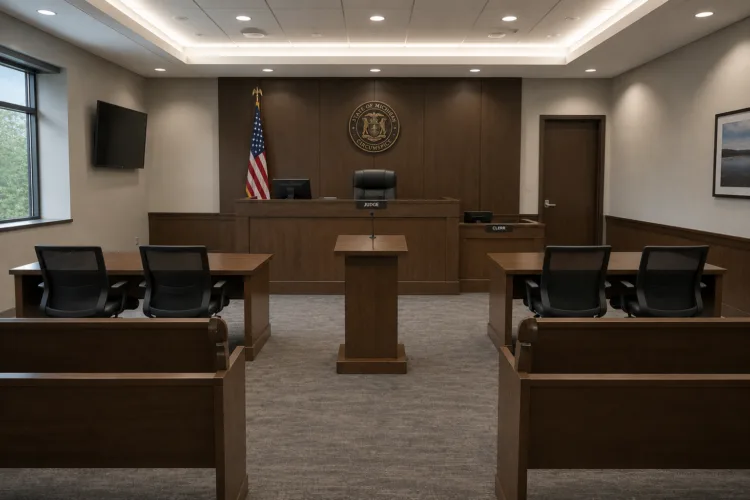
Empty Michigan district courtroom with judge's bench, American flag, and State of Michigan seal used in the DUI process

Unless a case is dismissed or won at trial, the pre-sentence investigation is, by far, the most important stage in the entire Michigan DUI process.

Michigan law requires that before a judge can sentence someone for a DUI, the defendant must complete a written alcohol use assessment (sometimes called a “screening”) and sit for an interview with a probation officer. This takes place after a plea or plea bargain has been reached, but before sentencing.

The probation officer then prepares a written sentencing recommendation for the judge. That recommendation is based on the facts of the case, any prior record, the numerical score from the alcohol assessment, the information provided during the interview, and the probation officer’s overall impressions. Every judge in every court follows this recommendation closely — often to the letter. The PSI report is, in practical terms, the blueprint for what the judge will do at sentencing.

This is why it is important to be properly prepared for the alcohol assessment and the probation interview. A better outcome at sentencing begins with a better recommendation from the probation officer, and a better recommendation begins with thorough preparation. For a detailed look at this stage, see our article on preparing for the alcohol assessment in a Michigan DUI case.

Sentencing in a Michigan DUI Case

The sentencing is the final court proceeding in the Michigan DUI process. It is the hearing at which the judge imposes the sentence — ordering what must be done and prohibiting certain other things.

In virtually all DUI cases, the sentence will include fines and costs, a period of probation, an order not to consume alcohol or drugs, and some form of testing to verify compliance. The specifics depend heavily on the PSI recommendation.

To illustrate: if the probation officer recommends long-term alcohol counseling, the judge will almost certainly order it. If the probation officer indicates that a single alcohol education session is sufficient, that is almost certainly what will be ordered instead. The recommendation shapes the sentence in a direct, predictable way — which is exactly why preparation for the PSI matters so much.

Our job at sentencing is to show up fully prepared, advocate effectively on the client’s behalf, and make the strongest possible case for the most favorable outcome. We are there to limit the penalties — including jail, when it is a real possibility — and to make sure no one gets saddled with classes, counseling, or treatment they do not genuinely need.

The Outcome of Your Case

One certainty in the Michigan DUI process is that it is going to cost money. The financial impact begins the moment you are released from jail — bond, impound fees, attorney fees, fines and court costs, probation supervision fees, higher insurance premiums, and any costs associated with counseling or education ordered by the judge. DUI cases generate significant revenue for courts and municipalities, and there is no way around that reality.

What skilled representation can do is make sure the financial hit is the worst of it. In many cases, particularly first offenses handled in the courts of the greater Detroit area, jail is not a realistic outcome if things are done right. Long, burdensome probation is often avoidable. Unnecessary treatment programs can frequently be headed off at the PSI stage.

The goal in every Michigan DUI case is the same: to avoid as many of the potential legal penalties and negative consequences as possible. In that regard, success is best measured by what does not happen to you. Beyond the inevitable financial consequence, the aim is to ensure the charge is seen as nothing more than a mistake in judgment — a single, out-of-character incident — and not something that follows a client into their professional life, their record, or their future. For a deeper look at how the “isolated incident” argument works, see our article on DUI as an isolated incident.

No one can do more, and we will never do less.

Talk to Our Office — Free and Confidential

If you are facing a DUI charge in Wayne, Oakland, Macomb, or one of the surrounding counties, our office offers free, confidential phone consultations Monday through Friday, 8:30 AM to 5:00 PM, at 586-465-1980. An after-hours answering service is also available, and you can reach us anytime through the contact form or chat box on our website. For more information about our practice, visit our Michigan DUI/OWI defense page.

About the Author
Jeff has been a practicing Michigan criminal lawyer, DUI attorney and driver’s license restoration lawyer for more than 30 years. He is passionate about winning and doing whatever it takes to accomplish that. He understands that a pending criminal or DUI charge is stressful and that being unable to legally drive is a huge problem.
Michigan State Police officer conducting a DUI traffic stop at night with emergency lights illuminating a suburban road
The Michigan DUI Process

Overview: How a Michigan DUI Case Works

This page provides a plain-English overview of the Michigan DUI process — how a typical case unfolds from the initial traffic stop through sentencing. For a deeper look at any individual stage — or at any aspect of Michigan drunk driving law — the DUI section of our blog contains hundreds of detailed, regularly updated articles and a search function to help find answers to just about any question.

One quick note on terminology: most people say “DUI,” but the technical term in Michigan is OWI — short for “Operating While Intoxicated.” Because virtually everyone uses “DUI,” we do too. For a full breakdown of Michigan’s drunk driving charges and penalties, including the differences between OWI, High BAC, and impaired driving, that article covers it in detail.

Every Michigan DUI process begins with some kind of police contact — a traffic stop, a response to an accident, or a welfare check. Whatever brought the police to you, the reasons for that first contact, everything that followed, and all the circumstances surrounding the arrest are legally significant and must be examined carefully.

After the arrest, you will be asked to submit to either a breath or blood test. How that plays out can make or break a case. Everything from the stop to the chemical test must be put under the legal microscope.

In most cases, you will be released from jail the next day with a citation, a temporary paper license in place of your regular one, and a number of things to sort out — including retrieving your vehicle from impound.

Choosing a Michigan DUI Lawyer

Once the immediate shock of a DUI arrest settles, most people start looking for legal help. This is the moment to slow down, not speed up.

Among the most important advice we can offer at this stage is not to make a rushed hiring decision — especially late at night or over a weekend, when emotions are running high and clear thinking is hard. Take the time to contact enough lawyers to make a real comparison. There is no downside to being a careful consumer when the stakes are this high.

The Michigan DUI process is unique among criminal matters. It involves overlapping legal and scientific questions that require specific knowledge and experience. While all DUI lawyers are criminal attorneys, not all criminal attorneys are DUI lawyers. That distinction matters when your case is being evaluated and negotiated.

The Traffic Stop and Police Investigation

How and why did the police make contact with you? These opening questions can shape everything that follows.

In our years of DUI practice, we have seen just about every scenario: clients who fell asleep at a drive-thru, others pulled over on a cell-phone tip about an erratic driver, people involved in accidents, and — most commonly — drivers stopped for swerving or erratic driving. Whatever the circumstances, the reasons for that first police contact are critically important. The police must have a valid, legal basis to stop a vehicle or ask a person to submit to field sobriety tests.

Beyond the initial stop, we also examine how the investigation was conducted afterward. The specific tests you were asked to perform, how they were administered, and your performance on them are all subject to legal scrutiny. The police cannot improvise tests on the spot — there are established standards, and deviations from those standards can affect the admissibility of the evidence.

Your DUI Arrest

If you are reading this for yourself, you have already been through this stage. An arrest for DUI in Michigan typically follows a field investigation in which the officer determines there is probable cause to believe you were operating a vehicle while intoxicated.

When we meet with a new client, we go over everything that took place before, during, and after the arrest. We obtain and review all available evidence — the police report, any body-cam and dash-cam video, breath or blood test results, and field sobriety test records. The goal is to get the complete picture, identify any legal or procedural problems, and determine whether any evidence can be challenged or suppressed.

After arrest, your vehicle will typically be towed to impound. You will need to retrieve it once you are released, which usually happens the following day.

The Arraignment

The arraignment is the first formal court proceeding under Michigan’s OWI law. It is a hearing at which a judge or magistrate formally informs you of the charges against you and sets the conditions of your bond.

Unless specifically advised otherwise by a DUI lawyer who is fully familiar with the facts of the case, a person should always enter a “not guilty” plea at this stage. Doing so preserves every option — including the possibility of getting a charge dismissed or reduced through pretrial negotiations.

Bond conditions at arraignment almost always include an order to refrain from consuming alcohol or drugs, a prohibition on leaving the state without the court’s permission, and a requirement to submit to periodic testing to verify compliance. If you posted a cash bond at the police station before being released, that amount will generally be accepted by the court at arraignment.

In some first offense DUI cases, the arraignment can be “waived” — meaning your attorney files paperwork with the court, a “not guilty” plea is automatically entered on your behalf, and you skip the arraignment appearance entirely. This option is available in some (but not all) courts in the greater Detroit area of Wayne, Oakland, Macomb, and the surrounding counties, though with limitations depending on the specific charge. It is generally not available for second offense DUI cases, High BAC cases, or any third offense felony DUI.

For more on how Michigan courts handle the early stages of criminal and DUI cases, see our article on district and circuit courts in Michigan.

The Pre-Trial Conference

The pre-trial conference is the working stage of the Michigan DUI process — and in most cases, it is where the outcome is actually determined. It is a meeting between the defense lawyer and the prosecutor to discuss how the case can be resolved without going to trial. Our detailed article on the pre-trial process covers what happens at each stage.

Our priority at the pre-trial stage is straightforward: get the charge dismissed if the evidence isn’t solid, or, if the evidence is too strong to overcome, negotiate it down as far as possible. A plea bargain typically means the original DUI charge is dismissed in exchange for a plea to something less serious — most often impaired driving (OWVI), which carries lighter penalties. In some cases, the resolution takes the form of a sentence agreement, which might specify no jail time regardless of the plea.

The overwhelming majority of DUI cases are resolved through pretrial negotiations rather than trial. It is common for there to be more than one pre-trial conference before a case is worked out. That is normal, and it is not a sign that things are going poorly.

Going to Trial in a Michigan DUI Case

Trials are rare in DUI cases, and for good reason.

A trial occurs when the defense and prosecution cannot reach a mutually acceptable resolution. It results in a verdict of either guilty or not guilty, and can be held before a jury or before a judge alone (called a bench trial). Nobody should go to trial in a DUI case unless there is a genuine basis for confidence in the outcome.

The official statistics from the Michigan State Police Annual Drunk Driving Audit — which tracks every alcohol-related traffic arrest in the state — show that fewer than one-quarter of one percent of all DUI arrests go to trial and result in an acquittal. That figure is not a reason for despair; it is a reason to understand where the real leverage in a DUI case lies. The odds of getting a charge dismissed or reduced through pretrial negotiations are substantially better than the odds of winning at trial. This is why the vast majority of DUI cases are resolved through plea and sentence agreements rather than by verdict.

The Pre-Sentence Investigation (PSI)

Empty Michigan district courtroom with judge's bench, American flag, and State of Michigan seal used in the DUI process

Unless a case is dismissed or won at trial, the pre-sentence investigation is, by far, the most important stage in the entire Michigan DUI process.

Michigan law requires that before a judge can sentence someone for a DUI, the defendant must complete a written alcohol use assessment (sometimes called a “screening”) and sit for an interview with a probation officer. This takes place after a plea or plea bargain has been reached, but before sentencing.

The probation officer then prepares a written sentencing recommendation for the judge. That recommendation is based on the facts of the case, any prior record, the numerical score from the alcohol assessment, the information provided during the interview, and the probation officer’s overall impressions. Every judge in every court follows this recommendation closely — often to the letter. The PSI report is, in practical terms, the blueprint for what the judge will do at sentencing.

This is why it is important to be properly prepared for the alcohol assessment and the probation interview. A better outcome at sentencing begins with a better recommendation from the probation officer, and a better recommendation begins with thorough preparation. For a detailed look at this stage, see our article on preparing for the alcohol assessment in a Michigan DUI case.

Sentencing in a Michigan DUI Case

The sentencing is the final court proceeding in the Michigan DUI process. It is the hearing at which the judge imposes the sentence — ordering what must be done and prohibiting certain other things.

In virtually all DUI cases, the sentence will include fines and costs, a period of probation, an order not to consume alcohol or drugs, and some form of testing to verify compliance. The specifics depend heavily on the PSI recommendation.

To illustrate: if the probation officer recommends long-term alcohol counseling, the judge will almost certainly order it. If the probation officer indicates that a single alcohol education session is sufficient, that is almost certainly what will be ordered instead. The recommendation shapes the sentence in a direct, predictable way — which is exactly why preparation for the PSI matters so much.

Our job at sentencing is to show up fully prepared, advocate effectively on the client’s behalf, and make the strongest possible case for the most favorable outcome. We are there to limit the penalties — including jail, when it is a real possibility — and to make sure no one gets saddled with classes, counseling, or treatment they do not genuinely need.

The Outcome of Your Case

One certainty in the Michigan DUI process is that it is going to cost money. The financial impact begins the moment you are released from jail — bond, impound fees, attorney fees, fines and court costs, probation supervision fees, higher insurance premiums, and any costs associated with counseling or education ordered by the judge. DUI cases generate significant revenue for courts and municipalities, and there is no way around that reality.

What skilled representation can do is make sure the financial hit is the worst of it. In many cases, particularly first offenses handled in the courts of the greater Detroit area, jail is not a realistic outcome if things are done right. Long, burdensome probation is often avoidable. Unnecessary treatment programs can frequently be headed off at the PSI stage.

The goal in every Michigan DUI case is the same: to avoid as many of the potential legal penalties and negative consequences as possible. In that regard, success is best measured by what does not happen to you. Beyond the inevitable financial consequence, the aim is to ensure the charge is seen as nothing more than a mistake in judgment — a single, out-of-character incident — and not something that follows a client into their professional life, their record, or their future. For a deeper look at how the “isolated incident” argument works, see our article on DUI as an isolated incident.

No one can do more, and we will never do less.

Talk to Our Office — Free and Confidential

If you are facing a DUI charge in Wayne, Oakland, Macomb, or one of the surrounding counties, our office offers free, confidential phone consultations Monday through Friday, 8:30 AM to 5:00 PM, at 586-465-1980. An after-hours answering service is also available, and you can reach us anytime through the contact form or chat box on our website. For more information about our practice, visit our Michigan DUI/OWI defense page.

About the Author
Jeff has been a practicing Michigan criminal lawyer, DUI attorney and driver’s license restoration lawyer for more than 30 years. He is passionate about winning and doing whatever it takes to accomplish that. He understands that a pending criminal or DUI charge is stressful and that being unable to legally drive is a huge problem.
Website developed in accordance with Web Content Accessibility Guidelines 2.2.
If you encounter any issues while using this site, please contact us: 586.465.1980