
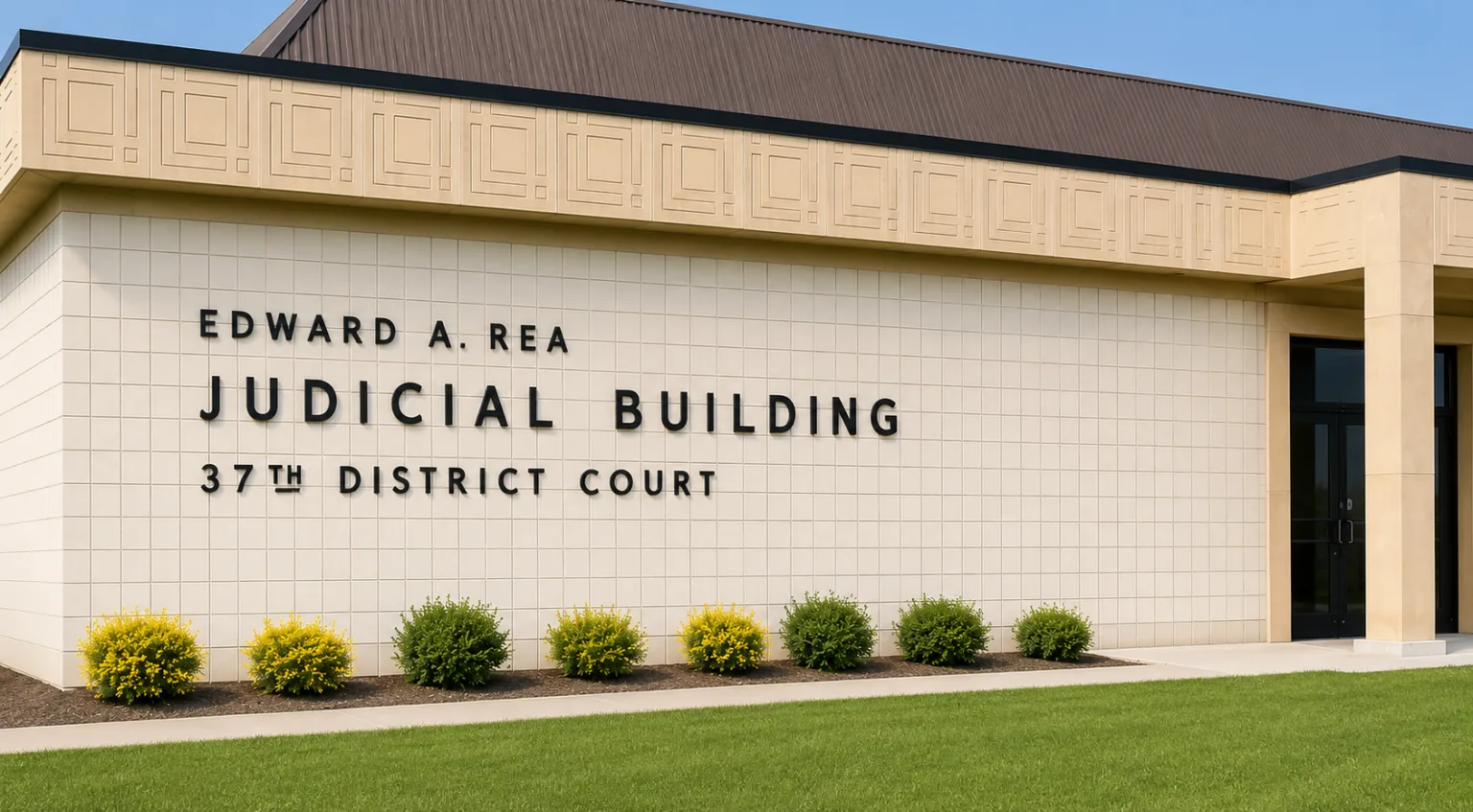

DUI Cases in the 37th District Court (Warren)
Geography and Jurisdiction
Warren is the largest city in Macomb County, with a population of roughly 139,000 people, and the 37th District Court reflects its size. It is the busiest district court in the county — busy enough that it runs two state case days every week just to keep up with the volume. If you were arrested for a DUI anywhere in Warren or Center Line, this is where your case will be heard.
Like most Macomb County courts, the 37th is a fair and decent place to have a DUI case. The volume of cases that move through here means the court simply does not have a desire to “grind down” a person who has made a mistake. Instead, the general attitude is more like “let’s address this and send you on your way so that you don’t do that again.” That, of course, always works in a person’s favor.
Even so, no one should mistake “fair” for “easy.” The judges here take their work seriously, and so does the prosecution. Our firm handles DUI cases in the 37th District Court on a regular basis, and we know this court well. What follows is an honest look at what to expect.
The 37th District Court has jurisdiction over all misdemeanor and criminal traffic cases — including DUI and OWI — arising in the cities of Warren and Center Line. It operates out of two locations: the main courthouse at 8300 Common Road in Warren, and a satellite location at 7070 E. Ten Mile Road in Center Line. All four judges are based in Warren, and rotate to the Center Line facility on a monthly basis.
Center Line is a small city of about 8,500 people situated entirely within the borders of Warren. For practical purposes, a DUI in Center Line follows the same process and lands before the same bench as a DUI in Warren.
Warren is the third-largest city in Michigan and covers 34 square miles, stretching from 8 Mile Road at the Detroit border north to 14 Mile Road, and from Dequindre Road on the west (the Oakland County border) to Hayes Road on the east (the Roseville and Eastpointe border). The Warren Police Department is one of the most active law enforcement agencies in Macomb County, with a significant traffic enforcement presence on major corridors including Van Dyke, Schoenherr, Mound, and the Mile Roads. The Michigan State Police frequently patrol I-696, which runs through the city, as well as all the major roads.
The Judges of the 37th District Court
Four judges currently preside over the 37th District Court:
Judge John M. Chmura — the longest-tenured member of the bench, appointed in 1996 and serving as Chief Judge since 2008. Judge Chmura is known for high professional standards and thorough engagement with the cases before him. Attorneys who appear here regularly know to come fully prepared.
Judge Michael C. Chupa — appointed in 2013 and elected the following year. Judge Chupa came to the bench with a background in criminal defense work and played a role in establishing a treatment court program before joining the 37th District Court.
Judge Suzanne L. Faunce — elected in 2014 after sixteen years as an assistant prosecuting attorney with the Macomb County Prosecutor’s Office. Judge Faunce is a Warren native and brings prosecutorial experience to her work on the bench.
Judge Steven M. Bieda — appointed by Governor Whitmer in February 2023. Judge Bieda is a lifelong Warren resident and a legal professional with a background in tax law and administrative adjudication.
Across the bench, our experience in this court has been consistent: the judges here are fair-minded and willing to listen. Preparation matters, and our firm’s familiarity with this court — and with each judge individually — makes a real difference in how a case unfolds.
What Kind of Court Is the 37th District Court for a DUI?
This is a fair court — and a busy one. Those two things are connected. Warren is a major city, and the 37th District Court handles a caseload that reflects that. The volume alone means that cases here are not drawn out unnecessarily, and that defendants are not subjected to the kind of grinding, punitive approach that can characterize some courts elsewhere in the region.
That does not mean consequences are light. A DUI conviction in the 37th District Court will carry real penalties, and the court expects defendants and their attorneys to take the process seriously. But in our experience, the judges here approach DUI cases with proportionality. Someone facing a genuine first offense who is properly represented, and who has taken appropriate steps since their arrest, is going to be treated very differently than someone who seems to have a “blow-off” attitude about what is happening.
Probation here is generally always fair — and in a court this busy, the probation department does not pile on conditions without reason. The court has its own probation department located at the Warren courthouse, which serves defendants from both Warren and Center Line. Our clients have consistently found that the probation staff here is reasonable to work with.
For context, our firm handles cases throughout Wayne, Oakland, Macomb, and the surrounding counties, and the 37th is a court we’re always happy to find ourselves representing someone. There is never any dread about appearing here.
Who Prosecutes DUI Cases in the 37th District Court?
The prosecution structure at the 37th District Court has three tracks, depending on how the charge is filed:
State-law OWI charges are handled by the Macomb County Prosecutor’s Office. The 37th District Court runs two state case days per week, a reflection of just how many state-law cases move through here.
Warren ordinance cases — including almost all first offense DUI cases involving an arrest by the Warren Police Department — are brought under local ordinance violations rather than state statute, and are handled by the City of Warren’s in-house city attorney’s office.
Center Line ordinance cases are handled by a private law firm that serves as the city’s city attorney.
For all DUI defendants, the relevant prosecutor will be one of these three entities. Knowing how each of those offices approaches cases in the 37th District Court — and having an established working relationship with the prosecutors who appear here regularly — is part of what our firm brings to every case.
First Offense DUI in the 37th District Court
A first offense OWI under MCL 257.625 is a misdemeanor carrying up to 93 days in jail, fines and costs, license sanctions, and probation.
A High BAC charge — where the driver’s blood alcohol content is 0.17 or above — increases the potential jail exposure to 180 days and carries a mandatory 45-day hard suspension followed by 10½ months on a restricted license with an ignition interlock device required. High BAC is a first-offense enhancement only; a prior conviction within seven years converts the charge to a second offense, making High BAC inapplicable.
In the 37th District Court, a well-handled first offense typically does not result in jail time for someone without a prior criminal history who has otherwise conducted themselves appropriately since their arrest. Our first goal in every DUI case is to find a basis to get the case dismissed. If the evidence is too solid to prevent that, then our focus shifts to negotiating a reduction to a lesser charge.
Ultimately, we want to obtain the best possible outcome at sentencing. In other words, we must do what’s necessary to avoid as many of the legal penalties and negative consequences as possible. Put another way, that means steering clear of jail, reducing probation conditions, and protecting the client’s license.
Success in a DUI case is always best measured by what does not happen to you.
Second Offense DUI in the 37th District Court
A second offense OWI within seven years is a misdemeanor carrying up to one year in jail, higher fines, and a mandatory minimum license revocation. The stakes at sentencing are meaningfully higher than a first offense, and the court’s approach reflects that.
One important option for second offense defendants in the 37th District Court is the Sobriety Court program. Sobriety Court can override the mandatory license revocation that would otherwise apply to a second offense — a significant practical benefit that is worth exploring in any eligible case. The 37th District Court’s Treatment Court program is one of the most established in Macomb County; more on that below.
In Macomb County, it is sometimes possible to negotiate a reduction of a second offense charge, depending on the facts and the prosecutor’s position. Our firm evaluates that possibility in every second offense case we handle here.
Third Offense DUI in the 37th District Court
A third offense OWI is a felony under Michigan law. Because the 37th District Court is a district court, it handles the arraignment and preliminary examination stages of a felony DUI case, but the matter is ultimately bound over to the Macomb County Circuit Court for trial and sentencing if it proceeds as a felony.
In Macomb County, a third offense felony DUI can sometimes be reduced to a second offense misdemeanor through negotiation with the prosecutor. This is not guaranteed, and it depends on the specific facts, the defendant’s history, and the prosecutor’s position — but it is a genuine possibility here, and our firm pursues it aggressively in appropriate cases.
In those cases, it’s always important to consider an application to Sobriety Court.
The 37th District Court Treatment Court Program
The 37th District Court has one of the most well-established treatment court programs in Macomb County — and by most accounts, it was among the very first sobriety courts established anywhere in the county. That history matters, because it means the program is mature, well-resourced, and staffed by people who know what they are doing.
The Treatment Court operates three tracks:
Sobriety Court — for misdemeanor offenders, including DUI second offense. Two phases, completable in 12 months. $500 program fee.
Trac II — also for misdemeanor offenders. Two phases, completable in 12 months. $500 program fee.
Drug Court — for felony offenders. Three phases, completable in 18 months. $1,000 program fee. Successful completion may result in a reduction to a misdemeanor.
Judge Chupa presides over the Treatment Court. The program provides intensive supervision and treatment support, including outpatient counseling, residential treatment, and drug testing. Cases from other jurisdictions can transfer into the 37th District Court’s Treatment Court program.
For a second offense DUI defendant, or a third offender whose charge can be reduced to a second offense, Sobriety Court carries one particularly important benefit: successful participation can override the mandatory license revocation that would otherwise apply. That alone makes it worth a serious conversation with us about whether it is the right path for your situation.
How Our Firm Approaches DUI Cases in the 37th District Court
Our firm has handled a significant number of DUI cases in the 37th District Court, and we know this court well — the judges, the prosecutors, and the probation department. That familiarity is not a small thing. Knowing how each judge approaches sentencing, how a particular prosecutor handles negotiation in this court, and what the probation department actually looks for means we can give clients an accurate picture of what to expect and develop an intelligent strategy for success from the start.
Our approach in every case begins the same way: we look hard for any basis to challenge the stop, the arrest, or the evidence. If the case can be dismissed or significantly reduced on legal grounds, that is always the first priority. When the evidence is solid and the focus turns to sentencing, we work to minimize every consequence the law allows — avoiding jail, limiting probation conditions, and protecting the client’s ability to drive.
Because Warren is such a large and active city, we also handle a significant number of other criminal cases in the 37th District Court beyond DUI and OWI — including driving while license suspended or revoked (DWLS/DWLR), Operating While Visibly Impaired (OWVI), indecent exposure, embezzlement, and other misdemeanor offenses. If you’re facing any criminal charge in Warren or Center Line, we’re worth a call.
We handle DUI cases throughout Wayne, Oakland, Macomb, and the surrounding counties, including in the 37th District Court’s sister courts in Clinton Township (41B), Shelby Township (41A), Romeo (42-1), Rochester Hills (52-3), and Troy (52-4). If your case is in Warren, we are ready to help.
What You Need to Know
The 37th District Court is the busiest district court in Macomb County — fair, experienced, and well-organized. If you’ve been arrested for a DUI in Warren or Center Line, here’s what matters most: the steps you take right now, before your first court date, can make a significant difference in how your case resolves. The sooner we can talk, the more we can do.
Facing a DUI in Warren? Call Us.
Our firm offers free, confidential phone consultations — no obligation, no pressure. We’ll give you an honest assessment of your situation and what we can realistically do for you.
Consultations are available Monday through Friday, 8:30 AM to 5:00 PM. Call us at 586-465-1980, use the contact form on our website, or reach out through the chat box. An after-hours answering service is available outside of regular business hours.
If you’ve been arrested for a DUI in Warren or Center Line, the sooner we can talk, the better. Visit our Warren DUI page to learn more about how we handle cases in this area, or call us directly to get started.